I can do all five of the RLT winning strategies beautifully! So in a workshop or teaching it to my couples or in our Circles . Real life is where it gets interesting. This month at IFS Circles we are looking at two of them: responding with generosity and cherishing what you have. They sound like the easy ones. Be kind.. be grateful. anyone who has tried to be generous at the end of a long day whilst feeling hard done by and hurt knows it is not that simple.
A quick note before we start. I am not going to use my family as examples. Their moments are theirs, and it would not be fair to turn them into content. Where I give examples, they come from my own parts, or they are made up, or they are a blend of things I see over and over in the therapy room with my fab clients
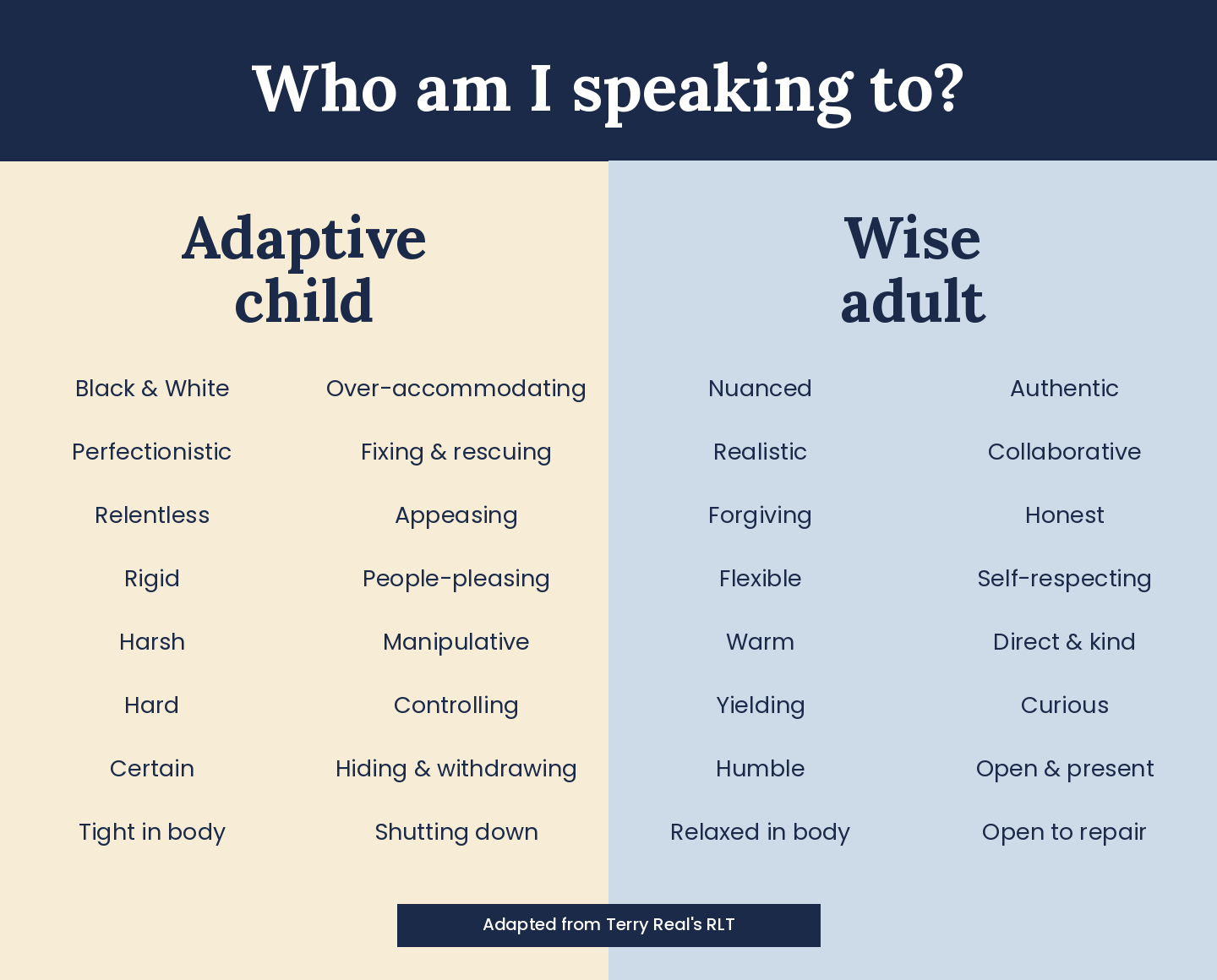
The RLT view: only the Wise Adult can do this
In RLT, the five winning strategies are: advocate for what you want, speak to make things better, listen to understand, respond with generosity and cherish what you have.
Terry Real is clear that these are not communication tricks. They are what a Wise Adult does, tools that are learnt. When we are in our Adaptive Child, the younger, protective part of us that learned to cope early on, we reach for the losing strategies instead: needing to be right, controlling, saying everything with no filter, retaliating or withdrawing (Real, 2007; 2018).
Responding with generosity starts with thinking ecologically. Our culture trains us to ask "what is good for me?" RLT asks "what is good for us?" If one of us wins and the other loses, we both lose, because the loser will find a way to make the winner pay. Your relationship is your biosphere. You can't escape it and you're not above it, you're in it (Real, 2022). That is why generosity is enlightened self-interest rather than self-sacrifice. It also asks for accountability, which means owning your part without a "but" on the end…
Then there is Terry Reals idea of relational jujitsu, which I love. Instead of meeting your partner's jab with a jab of your own, you duck under it. If they come at you with a dysfunctional stance, you answer with a functional one and lean in with a bit of vulnerability. Staying steady when someone else isn't.. is a good day for you and the relationship. Overtime maybe things can shift.
Cherishing what you have draws on John Gottman's research, which found that relationships can survive negative interactions, as long as there is repair… but thrive on positive ones. The ratio he is known for is five positives to every negative. Ideally 20 to each negative one! RLT adds two practical ideas to that:
Celebrate the glass 15% full. When someone makes the change you have been asking for, it is common to struggle to take it in, especially after repeated hurt. Naming that gives you a choice: stay protected, or be vulnerable and let it in. What we celebrate tends to grow.
Build a relational subculture. Scheduled weekly check-ins to acknowledge the positives, raise concerns and set intentions, so we don't slip back into old patterns. Also train up your friends so they don’t always take your side!
The IFS view
IFS agrees with RLT about who can do this, just in different language. In IFS we talk about Self: the calm, curious, compassionate core we all have, which does not need to be built, only unblended from. Dick Schwartz describes its qualities as the 8 Cs: calm, curiosity, clarity, compassion, confidence, courage, creativity and connectedness (Schwartz, 2021). The Wise Adult and Self are not identical ideas, but they do a similar job more or less.
Some of our parts have worked out what Self looks like, and they try very hard to do it for us (all parts have Self at their core too!). IFS calls these Self-like parts (Schwartz and Sweezy, 2020). They can say the right words, use the soft voice and remember the five strategies but they are doing it with an agenda or am intensity .. to be loved, to avoid being criticised, to get a bit of credit, to calm things down. They are a bit hologramy. The shape is right and it is convincing from a distance, but nobody is quite home. Also… the exiles underneath don't get what they need, they know. A Self-like part being generous at the little one is not the same as Self being with the little one. An exile may watch a polished performance of love go past and still might feel unseen. When a part with an agenda uses these strategies, they become tactics. When Self leads with an open heart, they become guidelines.
Other people can feel the difference
This is the bit that surprises people. Nobody needs to know the theory to feel it. Most of us have been on the receiving end of both. Have you? Our bodies are surprisingly good at telling these parts apart. It works the other way round too. When we meet someone whose generosity asks for nothing back, we tend to soften. Something in us relaxes. That is Self meeting Self, and it is very hard to fake.
This is not about being perfect or never having a Self-like part. We all have them, and mine are very convincing . They are not a problem to get rid of… no bad parts after all .. They are parts with good intentions, trying to get love the only way they have learned how. Which brings us to their friends..
The parts that push back and keep score
There is a whole crowd in me.. how about you? .. who resist generosity and cherishing, and every one of them is protecting something. You may have met some of them in this month's IFS Round Table videos:
The Ratio Keeper counts the positives and works out what is owed. "They owe me three." It protects us from being taken for granted.
The Wait-and-See Part in me doesn't get excited when someone finally does the thing we asked for, in case it doesn't last. It protects mefrom being let down again.
The Sarcasm Part laughs first, so nothing can sting.
The Winner and the Venting Part want to win, or to get it all out. The air always comes back round to here though 🥺
The Counter-Puncher swings back. The Killer-With-Kindness Part is so lovely it is a weapon.
The Optimiser makes a rota to be brilliant at everything. The Mind-Reader is sure it knows, without asking. The Dodger has just remembered somewhere else to be when someone mentions a check-in
None of them are the enemy. Most of mine have been around far longer than the relationship, and they step forward because an exile underneath is frightened: of being powerless, hurt again, unseen, not enough or too much. In IFS we don't wrestle them . We thank them, befriend them ..get curious about what they fear, and ask whether they would trust Self to take the wheel. Sometimes the first answer is "not yet", and that is fine.
At this month's IFS Circles
In circle we keep our usual shape: a meditation, mapping our parts, then a sculpt. This month you might map a part who keeps score, or a Self-like part who is very good at generosity, and notice what the little one underneath is hoping for. Come curious. You don't need a partner, or to have any of this figured out. These strategies apply to friends, parents, colleagues and the relationship we have with ourselves too.
One gentle reminder: circles are not a replacement for therapy, so if something big turns up, do look after yourself afterwards. Dates for Stroud, Cirencester and Cheltenham are here on the website
Two boats, or two cars side by side, each steering their own, in the same direction 🧡
Bibliography
Real, T. (2007) The New Rules of Marriage: What You Need to Know to Make Love Work.
Real, T. (2018) Fierce Intimacy: Standing Up to One Another with Love [audiobook].
Real, T. (2022) Us: Getting Past You and Me to Build a More Loving Relationship.
Schwartz, R. C. (2021) No Bad Parts: Healing Trauma and Restoring Wholeness with the Internal Family Systems Model.
Schwartz, R. C. and Sweezy, M. (2020) Internal Family Systems Therapy, 2nd edn