Finding Safety Within and With Each Other
On Co-Regulation, the Mind-Body Break, and Learning to Come Home to Yourself
“We don't solve problems when we're frightened. We solve problems when we're safe with others." Stephen Porges
A musing on what actually happens in the body when conflict arrives and why understanding your nervous system from the inside out, rather than just knowing about it intellectually, changes how you show up with the people you love. This blog pulls together polyvagal theory, IFS parts work, co-regulation, and what several schools of couples therapy have to say about the pause that makes repair possible 🧡
The Ladder: A Map of Where You Are
Polyvagal theory, developed by Dr Stephen Porges and brought into accessible, practical language by Deb Dana, gives us a map of the three states our autonomic nervous system moves between:
Ventral vagal — the state of connection, curiosity, calm, creativity. The territory where, in IFS terms, Self energy lives. Where we can think, feel, and relate. Where repair is possible.
Sympathetic — mobilisation. Fight, flight, frenzy, fume. The system flooding with cortisol and adrenaline, scanning for threat, readying for action. Not a broken state an adaptive one but not a state from which you can have a productive conversation.
Dorsal vagal — collapse, shutdown, disconnection. Fold, fog, fade, flop. The ancient freeze response. Also adaptive and also not a state from which connection is possible.
And then there are the mixed states. Freeze and friend between sympathetic and dorsal. Chronic fatigue seems to be a bounce between the two states of sympathetic and dorsal. Then there’s the joy of Ventral plus sympathetic which can look like cycling, swimming or dancing with a smile on your face, or passionate creative urgency. Ventral plus dorsal can look like deep, dreamy rest lying in the sun, half-listening to music.
The point of the map isn't to get to ventral and stay there forever. We move between states all the time . Janae Elisabeth (Trauma Geek), an Autistic researcher and educator whose work I find essential on this, names this clearly: 'ventral supremacy' which is the assumption that regulated connection is the goal at all times is a problem. Stress responses are adaptive. They only become traumatic when we get stuck in them. The aim is flexibility and flow, not permanent residence in any one state.
Safety Is Not Just an Inside Job
Here's something that gets missed in a lot of self-help framing: we cannot regulate ourselves fully alone. We are not designed to. Our nervous systems are social systems built, from the very beginning, to find safety through other people.
Co-regulation begins before birth. In the womb, a baby is already registering the rhythm of their mother's heartbeat, the sound of her voice, the quality of her movement. After birth, when a caregiver picks up a distressed infant, makes eye contact, uses a soft voice, rocks gently something remarkable happens. The baby's flooded nervous system begins to settle. safety communicated through the body of another person.
As Deb Dana writes, regulation is a shared experience. We don't think our way out of fear instead we feel our way out of it, through the presence of someone whose system is coherent enough to lend us some of theirs.
It is through thousands of these co-regulatory moments so like being soothed, attuned to, held in someone's calm presence, that a child's nervous system gradually learns to self-regulate. The capacity for self-regulation is not innate. It's built, slowly, through relationship.
What Happens When We Didn't Get Enough
Many of us didn't get enough co-regulation. Likely because our parents themselves didn't get enough, and were doing their best from depleted, unregulated systems of their own. Generational cultural legacy burden energy
When the co-regulation a child needs isn't reliably there, or when the caregiver is themselves the source of threat then the nervous system adapts. It learns to do what it can alone.
It develops protective parts in IFS terms: managers who keep everything controlled and contained, firefighters who step in when the system floods, and underneath them all, exiles carrying the longing for the safety and attunement that wasn't there.
This isn't a life sentence. Janae Elisabeth is clear on this: nervous system maturation through co-regulation can happen at any point in life so if we have access to regular, consistent co-regulation. co-regulation doesn't only come from people. It comes from animals, from nature, from the quiet steadiness of a morning routine, from being in a room of other nervous systems that are settling together. (Which is, incidentally, part of what the IFS Circles offer 💜)
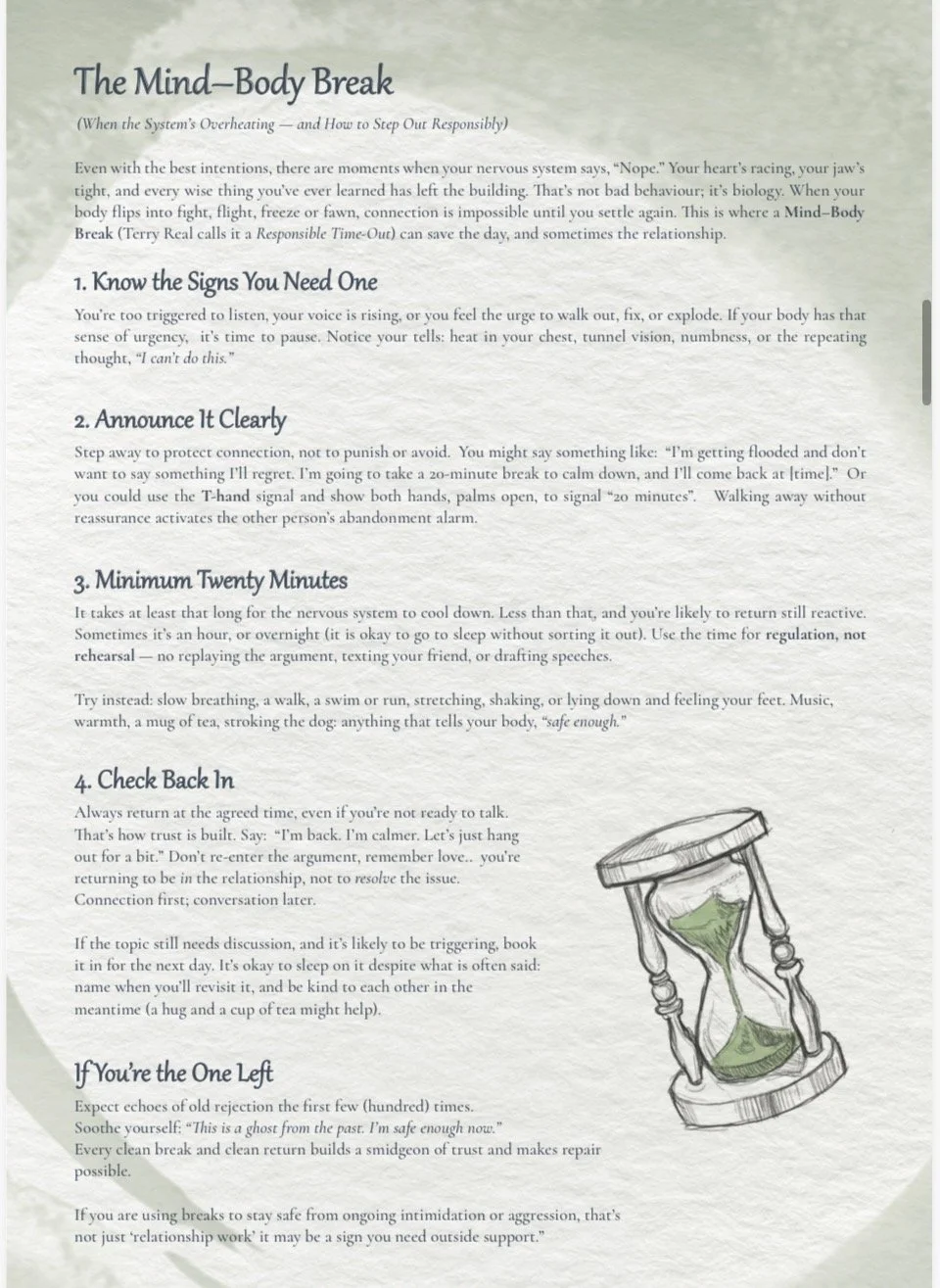
When the System Floods: The Mind-Body Break
Even with all the self-awareness in the world, we will still get triggered. The body will still flood. A part will still take the wheel. it's the nervous system doing its job.
Stephen Porges puts it simply: "We don't solve problems when we're frightened. We solve problems when we're safe with others." This is not a metaphor. When heart rate exceeds 100 beats per minute, the capacity for coordinated, empathic communication becomes functionally impossible not difficult, not unlikely, but impossible. The hardware is genuinely not available. Asking someone in that state to listen well, take responsibility, or stay curious is a neurologically impossible request.
This is something multiple schools of couples therapy have independently arrived at. John Gottman, whose research involved observing thousands of couples in his laboratory, coined the term 'flooding' : Diffuse Physiological Arousal and demonstrated clearly that it takes at least twenty minutes for the body to physiologically calm down, and that anything more than a day can begin to feed negative sentiment. Relational Life Therapy calls it a Responsible Time-Out emphasising that word responsible, because the pause is an act of relational care, not abandonment. Sue Johnson's Emotionally Focused Therapy talks about de-escalating the negative cycle the pursue/withdraw, attack/defend dance as the first move before any deeper work becomes possible.
Different lenses, same body truth: you cannot have a good conversation from inside a stress response.
The IFS Addition — the U-Turn
Where an IFS-informed approach and specifically IFIO (Intimacy from the Inside Out), developed by Toni Herbine-Blank for couples work adds something distinct is in what it invites you to do during the pause. Rather than simply waiting for the cortisol to clear, IFIO would invite a U-turn: turning attention inward, away from what your partner just did, and toward what just happened inside you.
Which part just took over? Where do you feel it in your body? What is it afraid of? What did it just remind you of that has nothing to do with this conversation?
This is not navel-gazing. It's the most practically useful thing you can do with twenty minutes, because the part that just flooded is usually not primarily about what happened thirty seconds ago. It's carrying something older. If you return to the conversation without spending any time with it, it will still be running the show just more quietly.
The responsible pause, in this framing, becomes: step away, signal clearly, set a return time then turn inward. Let the nervous system settle. Spend some time with whatever part just showed up. Then come back, not because everything is resolved, but because you're regulated enough to be present, and because the relationship is worth returning to.
How to Take a Responsible Pause
Know the signs you need one. Voice rising, urge to say something sharp, urge to fix or flee. Or the opposite numbness, flatness, going somewhere else inside. Heat in the chest, tunnel vision, the thought I can't do this. These are your body's signals. Trust them.
Name it briefly. "I'm getting flooded. I don't trust myself right now to stay well in this. I'm taking twenty minutes and I'll be back." Or use a pre-agreed hand signal. The words are less important than the implicit message: I'm stepping away to protect this, not to escape it.
Use the time for regulation, not rehearsal. Walk, breathe, move, warm your hands, stroke the dog. The physiological sigh (double inhale through the nose, long slow exhale) works quickly. No replaying the argument, no drafting speeches, no texting friends to vent. Turn toward whatever part just showed up if you can
Check back in at the agreed time. Even if you're not ready to re-enter the conversation. "I'm back. I'm calmer. Can we just be together for a bit before we talk?" Connection first. Conversation later. The return is how trust is built.
If You're the One Left Behind
When a partner takes a pause and the old terror of abandonment fires that's not irrational. It's your nervous system doing precisely what it learned. The echoes of every previous disappearance are in there. Soothing yourself: this is a ghost from the past. I'm safe enough now. Every clean return builds a small increment of new learning. The nervous system is slow to update. Be patient with it.
The Bigger Picture
Janae Elisabeth asks a question I keep returning to: what is the purpose of learning about nervous system science? Are we using it to support the status quo, or to liberate each other from harmful systems of power? Are we learning about our bodies to control them, or to accept them?
These are not rhetorical questions. The polyvagal framework has sometimes been misused to pathologise neurodivergent responses, to suggest that people should be able to regulate their way out of genuinely unsafe environments, to put the burden of change entirely on the individual nervous system. She is clear, and I agree: sensory overwhelm is a real danger. Trauma responses are real responses. Attuned neuroception is more accurate than faulty neuroception as a frame for many neurodivergent experiences.
The nervous system science I find most useful is the kind that helps us meet ourselves with compassion, build genuine safety in relationship, and recognise that we are not isolated units to be optimised we are relational beings, embedded in communities, histories, and systems that shape what safety is even possible for us.
Finding safety within is real and important work. It just doesn't happen in isolation.
References and Further Reading
Porges, S. W. (2011). The Polyvagal Theory. Norton.
Dana, D. (2018). The Polyvagal Theory in Therapy. Norton.
Dana, D. (2020). Polyvagal Exercises for Safety and Connection. Norton.
Gottman, J. M. & Silver, N. (1999). The Seven Principles for Making Marriage Work. Crown.
Herbine-Blank, T. (2015). Intimacy from the Inside Out.Routledge.
Real, T. (2007). The New Rules of Marriage. Ballantine Books.
Schwartz, R. C. (2021). No Bad Parts. Sounds True.
Elisabeth, J. (Trauma Geek). traumageek.com — especially 'Polyvagal is Not Dead' and 'The Neurodiversity Paradigm: Beyond the Basics'.