All that glitters (and the parts that make us shine a little too brightly)
There's a part of me that feels superior to others, entitled, higher up a ladder. She has views and rules that others really should follow. I know this part well.
Let's have a meander about grandiosity. The everyday kind, rather than the clinical full-blown narcissistic personality kind that gets all the attention🙃
Do you, like I, have a part that's absolutely certain it's right? That decides the problem is everyone else? That needs you to be special, because if you're not, the alternative is just awful?
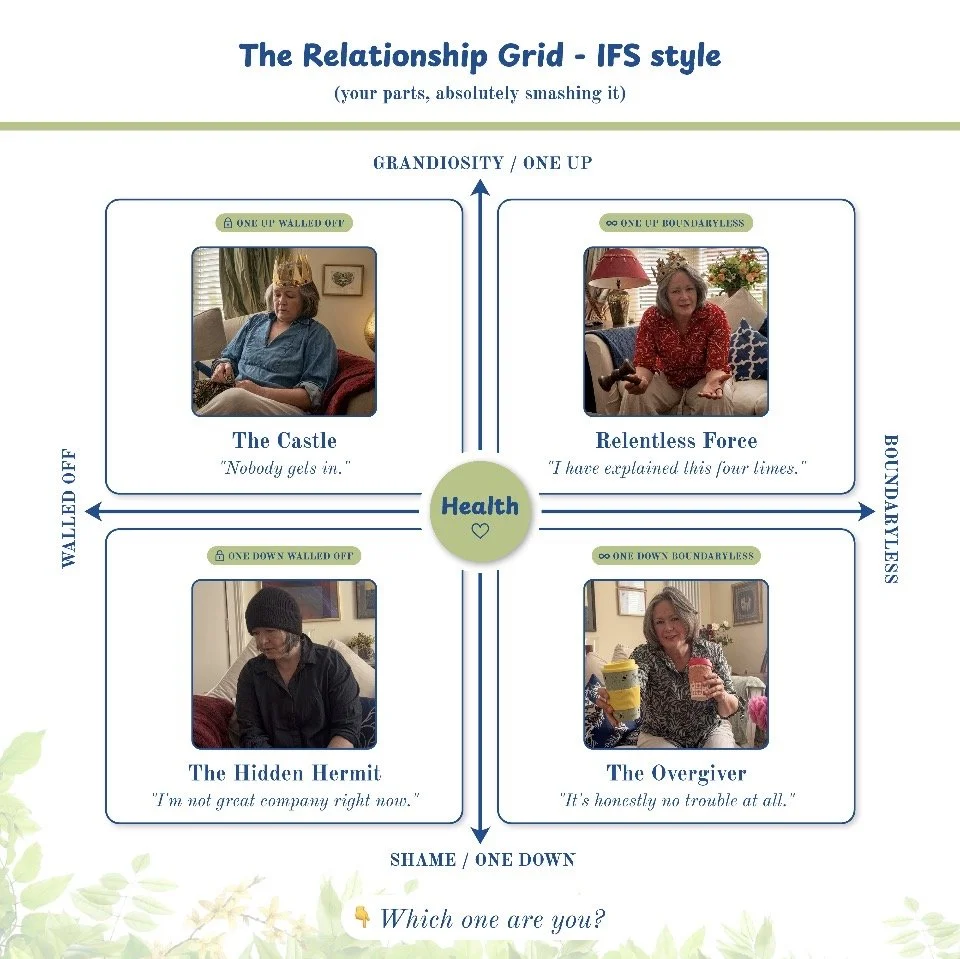
In RLT terms this is the one-up position: grandiosity on the self-esteem axis, the sense of being above it all, more than, entitled. It feels like power, confidence, clarity. it feels good. Other people are the issue.
Many of us in our society build our sense of worth on unstable external foundations: how we perform, what we have or how we look, or what other people think of us. When those sources tip upward, we go one-up. When they shift, we can crash. Grandiosity is one way the system tries to keep the floor from giving way.
Shame, at the other end of the axis, feels terrible and motivates change. Grandiosity feels like winning at life. Nobody rushes to dismantle something that feels this good.
The manosphere, as an example - those overlapping online communities built around male entitlement, dominance and grievance, looks to me like a grandiosity delivery system. Male loneliness, covert depression, shame and alienation are real. Romantic rejection, economic uncertainty, climate emergency, a world that no longer has a clear script for masculinity. Influencers offer grandiosity as the cure. The problem is not you, it's feminism and weak men. You are special and owed more. Become unapologetically dominant and everything will fall into place.
In IFS terms, I see this as a protector working big scale. Grandiosity sitting on top of genuine pain. The longing for belonging, meaning and dignity, the pull away from shame and loneliness. It makes so much sense, doesn't it? So alluring.
Coming back to me (see what I'm doing?! 👑)
I grew up with a mother who was blended with grandiosity. Everything revolved around her reality. It was like she was the sun and our experience wasn't real. Whatever my family or I did or said was challenged or made wrong, feelings invalidated, everything coming back to her.
How to survive this? I learnt to please and accommodate. Teenagerhood brought in my rebel parts and I flipped the script. My grandiosity flared and my contempt headed her way. When I found my way into 12-step rooms: Al-Anon, ACoA and others, I met something I wasn't expecting. My own shadow. So much of that work is a U-turn: stop looking at what they did and look at what's happening in you. A brilliant, uncomfortable introduction to parts work. When in my 40s I encountered IFS, it felt familiar 🧡. Here's what the U-turn revealed: I had narcissistic parts too. Not identical to my mother's, but there. The part that puffed up when I felt small. The part that needed to be the most competent person in the room. The part that, when someone else's behaviour set off my nervous system, was absolutely, completely, one hundred percent certain the problem was them.
There's a useful maxim I return to often: if it's intense, it's yours. Worth checking 🫣
In IFS, every protector part has good intentions. @When I enquire with these parts they tell me they want to make sure the exile underneath never gets exposed. Underneath the glitter, the entitlement, the certainty, the need to be right or special or above it, there are young parts carrying shame, worthlessness and powerlessness. The felt sense of being small, invisible, not enough, or fundamentally flawed. I can appreciate that. I can also see that when I speak from those puffed-up parts rather than for them, people get hurt.
Grandiosity has structural and cultural origins as much as personal. Some of it is modelled. Children absorb what they grow up with, getting a template of how to be an adult. Unconsciously : when I’m an adult I too will organise the household, my certainty when I’m grown will never be questioned, my needs, views and comfort will take precedence.
Some of it is cultural and generational. The British class system has been producing entitled, grandiose relational styles for centuries and calling it leadership, good breeding, or simply confidence. Boarding school. Born to rule. The child sent away young, forced into self-sufficiency, and handed an identity of superiority as compensation. Generations of it, passed down without examination.
Sylvia Duckworth's Wheel of Power and Privilege is worth naming directly here: when you sit at the centre of multiple axes of power, race, class, gender, ability, citizenship, you rarely have to notice. The world organises around you. Your experience becomes the default. Other people's realities become, at best, interesting and at worst, inconvenient. That is structural grandiosity. It doesn't feel like grandiosity from the inside. It just feels like normal.
Then there's the developmental piece, and this one is important and often missed. What is not lovingly limited or guided .. Every small child is, appropriately, a baby king. Grandiosity is developmentally normal at three, four, five. This is not a problem, it’s childhood. The job of the caregiving environment is to lovingly, warmly, consistently bring that child into contact with other people's reality. You matter. And so do they. That's the limit. Relational education, crucial. When that limit doesn't come, when the baby king's grandiosity goes unchallenged, they never get the loving boundary it needed. So we end up doing the work in our 30s, 40s or 50s, beyond
The neurodivergent thread: I imagine you'll not be surprised that I add a neurodivergent lens here. Some of what looks like grandiosity is wiring rather than wound. Justice sensitivity means a fierce, fast response that can look like arrogance from the outside but is a moral orientation from the inside, often an accurate one, arriving before the regulation does. Monotropic focus means deep absorption can come across as a bit much, or judgemental, when the brain has simply moved somewhere else. Impulsivity before the editing process has had a look in, and intention and delivery get spectacularly misaligned.
Invitation to notice where your wiring connects with this but of course none of this removes accountability. We still need to learn the relational skills to not hurt each other.
You might be reading this thinking: I don't have grandiose parts. I go the other way entirely. I apologise for everything. I hear you. I wonder though. The fiercely selfless position might itself be a protector. A part that learned, often in response to someone with narcissistic protectors, that the safest thing to do was disappear. I invite you to befriend that part too as the portal to the next level of freedom. Maybe there's a quiet polarisation happening: a loud part insisting I'm not selfish like them, and a quieter part longing for you to take up space, claim what you need, and shine without apology. Maybe?
The grounded confidence and clear pride we feel when we've genuinely done well. The capacity to say I'm good at this without immediately hedging it into oblivion. The ability to take up space, be seen, and let it feel okay.
When Self leads, that calm, curious, clear presence, there's a natural confidence and glow to it. Playful, spontaneous, joyful, Self-full. Genuinely and solidly yourself. That's the centre of the grid. Neither one-up nor one-down. The centre of health, for yourself and for the person in front of you. You may be better at tennis or earn more money, but your intrinsic worth is the same
The glitter is beautiful. It just works better when it's real
Which of your parts makes you shine a little too brightly? Who's it protecting underneath?
#Grandiosity #NarcissisticParts #IFS #InternalFamilySystems #RelationalLifeTherapy #PartsWork #TerryReal #HealthyNarcissism #Neurodivergent #JusticeSensitivity #SelfEnergy #RelationalGrid #Shame #AdaptiveChild #ShadowWork