
Warrior Mutiny - it’s not me .. it’s you: IFS and blaming others to avoid shame
This video and set of notes focus on IFS and the pull to blame others as a way to dodge shame… what Martha Sweezy describes as the fifth act in her Shame Cycle. For more about Martha’s work, see: https://marthasweezy.com/. We’ve spent this year exploring the protectors in the cycle (overview here: https://www.stroudtherapy.com/news/shameifs). You can watch the (approx.) 15-minute video below, or read on (I do take a few tangents!). I touch on Sweezy’s Shame Cycle, IFS and neurodifferences, Self-compassion and healing, Gottman’s relationship research, IFIO couples therapy, and polyvagal theory hopefully there are a few useful nuggets in here.
Why do we blame?
From an IFS perspective, the “warrior mutiny” is a set of hardworking protector parts that spring into action to spare us from exposure to shame. Instead of letting that pain land inside, they project it outward—criticising, judging, and attacking others. It’s a coping strategy: the intention is protective and often prosocial (“keep me safe; keep me belonging”), but the impact is usually disconnection, escalation, and further entrenchment of shame in the system. By viewing blaming and shaming through the IFS lens, we can see both other people’s behaviours and our own more clearly—meeting these parts with curiosity and compassion, while taking responsibility for repair.
In this talk I’m not focusing on speaking with the Confidence, Clarity, and Courage of Self—standing up to injustice or setting a firm boundary when a line has been crossed. Self can be connected and curious, and also appropriately fierce. It sounds like: “I don’t like that. Please stop.”
And a reminder: not everything comes down to shame. Responses may also be driven by fear, powerlessness, power imbalances, structural inequality, and very often overwhelm. For neurodivergent folk like me, protector parts often respond to our neurotype “hardware” (e.g., sensory processing differences, rejection sensitivity, hyperfocus, high empathy, alexithymia). If we become overwhelmed or melt down, it isn’t necessarily an exile being triggered. See the “Hardware & Firefighter Software” diagram (Candice Christiansen & Meg Martinez Dettamanti) below. When I’m already out of balance, the next tiny thing can tip me over—my firefighters rush in to douse the flames and may blame that thing.

To recap … Martha Sweezy’s excellent book on IFS and shame/guilt outlines the Six Acts of the Shame Cycle:
1 Something bad happens. An authority figure shames you: “What is wrong with you? You made me feel xxx.” It’s interpersonal, the child is passive. The message isn’t just that your behaviour is not okay you are bad/wrong.
2 Acceptance.“I am bad.” The child believes it, takes in the burden as identity: I’m worthless, unlovable. This is an adaptive move for a child: the world is safe and good; it’s me that’s bad.
Then comes the Curtain. Many aren’t even aware of this it can predate current problems by years.
Acts 3–6 can appear in different orders and often polarise with each other they’re the system’s way of protecting the original wound:
3 Inner Critics go large (proactive manager): self-blame Something’s wrong with me; it’s true, I’m bad.
4 Anticipatory Scouts (manager): the “Never again” motto. Reputation. Hide. Do it right. Eyes both out and in.
5 Warrior Mutiny (focus of this talk/notes below).
6 Feel-good Rescue Team (firefighters): soothe and numb drink, fantasy, shopping, etc.

Warrior Mutiny (Act 5): Firefighters
These parts distract from and deflect shame by turning the focus outwards—sometimes only in your head, sometimes out loud:
“You’re the problem; not me.”
Diminishing others by comparison to reboot self-esteem.
When they criticise externally, they believe they can control the environment and keep exiles at bay. They push painful, internal shame onto others because that’s easier to manage: “No—you are bad.” Their intentions are genuinely protective, though the impact can be costly. At times they’re active, rebellious and disinhibited; at others, they quietly eat you from the inside.
Invitation: notice whether you have a part like this. How does it show up—voice, image, sensation? Does it know you’re noticing it? What does it want you to understand? Let it know you get its anger and that its impulse to blame makes sense. Then ask your system: How does shaming someone tend to work for us? It may win short-term obedience, but it rarely gets what you truly want; it usually triggers a defensive shutdown in the other person.
Maybe there’s a different way.
The Exit: Self-led Compassion
We all have an innate antidote to shame: connection with Self. We can extend compassion to protective parts, then witness and re-parent the hurt child who carries the burden—and help that burden be released. Befriending protectors and learning their good intentions is the path. The answer is compassion.
If something has just happened and you’re hurting—perhaps between you and someone else and you recognise shame, try one of two routes (both lead to meeting parts with Self):
Route 1 — Martha Sweezy’s “oxygen mask”
Notice: Ouch that hurt. Take a few breaths. Comfort the vulnerable one before the shamers (inner or outer) jump in, and before the blaming part acts.
“Hi, I see you. It’s okay.. relax a little. I’m here. We don’t have to deal with them right now; I need a minute with the part that’s hurting. When that part feels better, we’ll decide how to respond.”
Try a small experiment: unblend, send compassion to the hurting one, then return and see what if anything needs doing.
Route 2 — IFIO (Intimacy From the Inside Out): the U-turn in relationships
Remember co-creation. When something stings, pause. Go back one step: what just happened? What was already true in your body and environment?
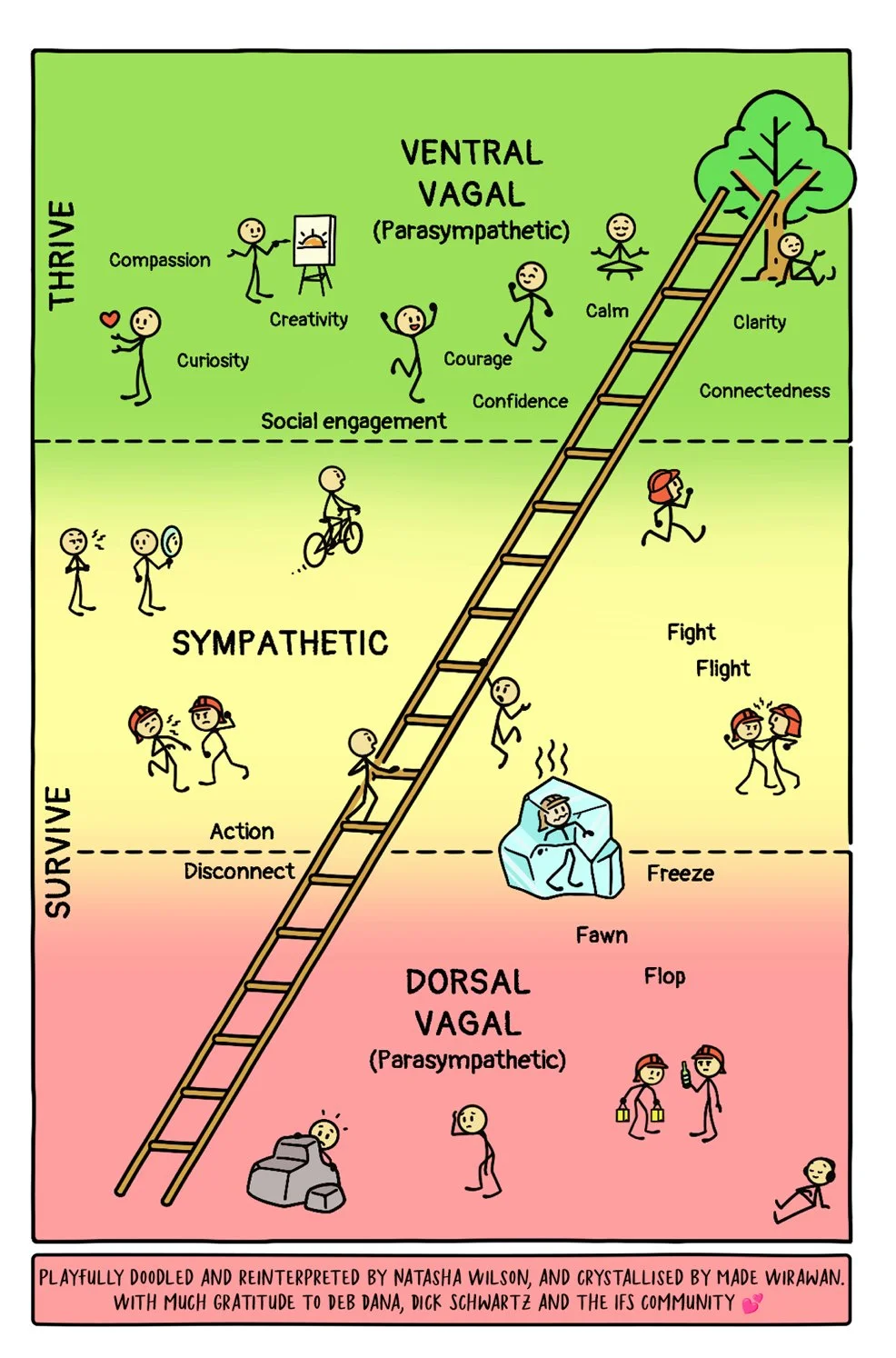
Track your nervous system (fight/flight/freeze/fawn see your polyvagal/IFS map).
Do a U-turn: recognise this as a part. Befriend and validate it.
Speak for the part, not from it: “When X happened, a blaming part jumped up in me; inside I felt …”
From there, you can return to the other for connection and co-regulation kindly and curiously.
It also helps to look behind their blame. See the protector and sense the vulnerability it guards—or, at times, recognise a neurodivergent trait at play (e.g., sensory overload). Not every reaction is an exile trigger; sometimes it’s neurology.

It’s complicated: what stems from childhood trauma, what belongs to Parts (the “software”), and what reflects how the brain works (the “hardware”)? It’s intricate but possible to discern.
This is especially important for neurodivergent folk (and really, for everyone). Notice where your sensory dials are turned up temperature, lighting, noise and how you can care for yourself to stay as safe as possible. Lower your stress bucket, return to a more regulated state, set boundaries, practise Self-care, and speak up for your needs.
A note on Relational Life Therapy (RLT) and “one-up” grandiosity
In RLT, Terry Real names grandiosity as a “one-up” stance being above, better than, or more entitled than the other. Through an IFS lens, that one-up posture can be a manager strategy (pre-emptive control, staying invulnerable by judging, correcting, lecturing) or a firefighter in full warrior mutiny (reactive attack to shove shame outwards). RLT helps us spot when we’ve left mutuality and slipped into grandiosity or its twin, “one-down” shame. The work is to move from the Adaptive/Protective Child (our parts) back into the Functional Adult (our Self): practising accountability, humility, repair, and “full-respect living”. In practice that sounds like: pausing the one-up move, naming the part (“I can feel my superior/teacher part online”), making a U-turn, and returning with a clear, boundaried, warm message that serves connection rather than domination.
Conclusion: Warrior Mutiny, shame, and the way through
Blame and shaming ie the warrior mutiny are protectors with good intentions: they try to keep unbearable shame off our skin. Whether they show up as cool, correcting managers or hot, explosive firefighters, their impact is costly: they escalate conflict, obscure our deeper hurt, and keep exiles alone.
The way through is familiar and brave:
Pause and U-turn. Track your nervous system; name the part that wants to attack; ask for a short recess inside.
Self first, then speak. Bring compassion to the hurt one; let protectors see you’ve got this. Return to the relationship speaking for parts, not from them.
Repair and accountability. From Self (or Functional Adult, in RLT terms), own impact, set clean limits, and make amends where needed.
Discern context and difference. Not every spike is shame-driven: neurodifferences (sensory overload, rejection sensitivity, alexithymia, dopamine droughts) can prime warrior mutiny. Build body-based regulation, explicit time-outs, clearer cues, and neuro-affirming agreements so traits (hardware) aren’t misread as character or malice.
Warrior mutiny is one of the most understandable moves a protective system can make. When shame threatens to land, parts that have learned "offence is the best defence" will do whatever it takes to redirect that pain outward. Criticising, judging, blaming, diminishing these aren't signs of a bad person. They're signs of a system doing its level best to keep an exile from being exposed.
The cost, of course, is real. Warrior mutiny escalates conflict, drives people away, and keeps the very wound it's protecting firmly in the dark. Shame thrives in isolation and in secrecy. The blaming move that was meant to protect ends up reinforcing the exile's deepest fear: that there's something fundamentally wrong with me, something that can't be seen, can't be known, can't survive contact.
The way through isn't to shame the shamer, in yourself or in anyone else. That just adds another layer to the cycle. The way through is the U-turn: pausing long enough to notice the warrior mutiny for what it is, bringing Self to the part that wants to attack, and finding underneath the fury or the cool contempt the hurt one who started all of this.
It takes courage to do that. It's much easier to stay in blame. Blame at least feels like power; vulnerability does not. Yet every time we manage even a small U-turn every time we catch the blaming part, name it, and choose to bring curiosity to what's hurting underneath — something in the system shifts. The exile gets a little less alone. The protector gets a little less desperate. The relationship, inside and out, gets a little more room to breathe.
Worth remembering, too: not every spike is shame-driven. For neurodivergent folk especially, sensory overload, rejection sensitivity, alexithymia, and nervous system dysregulation can all prime warrior mutiny without an exile in sight. Hardware and software interact in ways that are intricate and genuinely worth discerning. The invitation is to get to know your own system well enough to tell the difference and to build the regulation, the time-outs, the neuro-affirming agreements that make space for that discernment to happen.
Wherever your warrior mutiny comes from, the response is the same: compassion first, clarity second, repair when you're ready. Meet the blaming part with curiosity rather than condemnation. Find the vulnerable truth beneath. Speak for the part rather than from it, and return to connection from that cleaner, steadier place.
Shame softens when it's met with Self. That's everything.