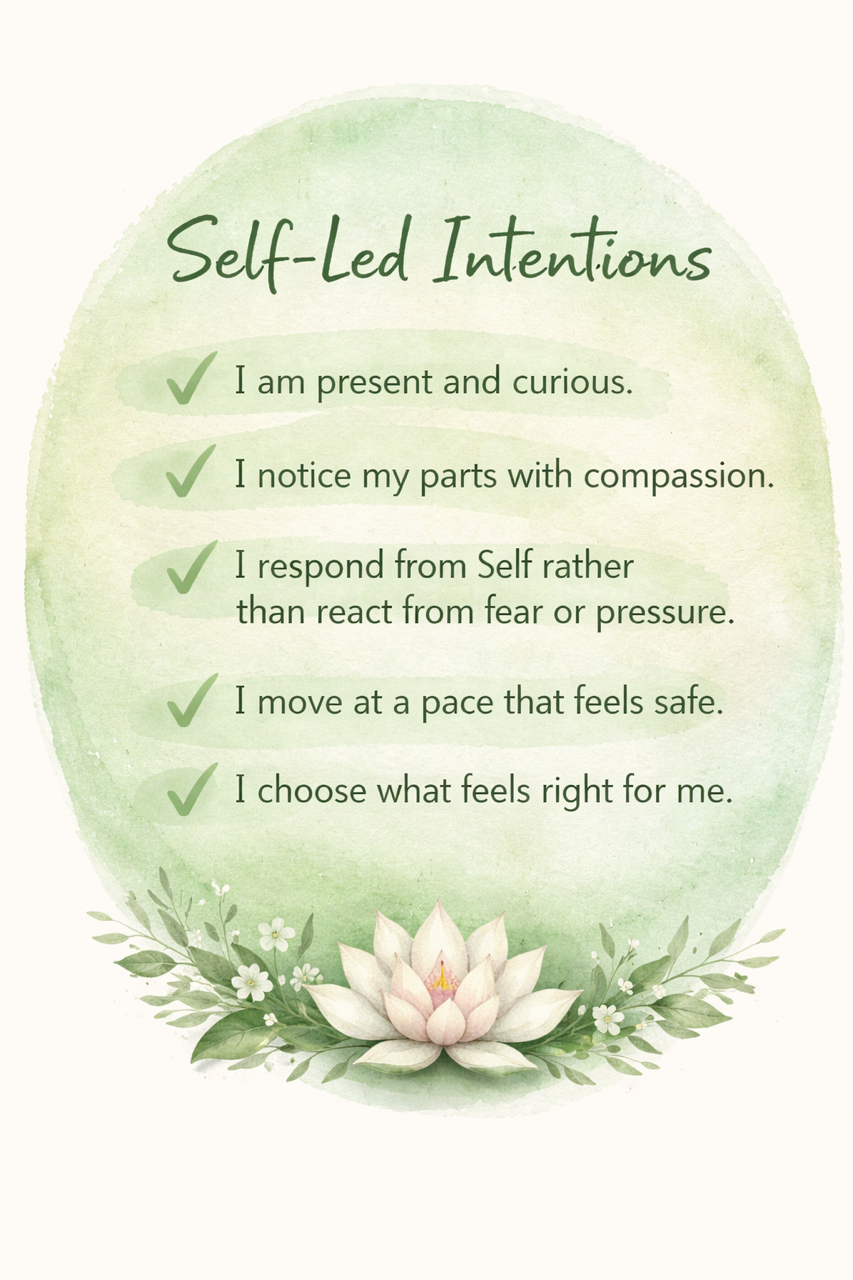
Self Led Intentions
In the IFS community circles we’ve been orienting to the year, arriving in winter - like a bulb waiting in the dark earth, resting, being not doing. The second part of our arriving is we’re moving gently from orientation into choice… So… what now? What am I meant to be doing? What should I work on? This is often where pressure sneaks back in.
In January, rather than rushing into goals or resolutions, we’re offering still that spaciousness, that pause, still being not doing… with Self-led intentions. This approach comes from Chris Burris and sits beautifully within Internal Family Systems and relational work.
Self-led intentions are not about striving or fixing. They are about creating enough internal safety for choice to emerge.
What is a Self-led intention?
A Self-led intention is written in the present tense, as if it is already happening, not because everything is sorted, but because we are inviting the nervous system to experience what Self leadership feels like now, even briefly. It is the difference between: “I need to stop reacting in relationships” and: “I am noticing my reactions with curiosity and staying connected to myself”
Chris Burris talks about how human systems are very quick to register what is wrong. Pain, conflict, fear, shame and frustration all show up fast. A Self-led intention gently converts that reaction into something creative and connective, without bypassing what is real.
Why this matters in relationships
In relationships, parts are constantly activated. One part may want clarity and direction. Another may want to avoid looking at anything. Another may be trying very hard to learn how to do connection properly. A Self-led intention does not silence these parts. It makes space for them. Rather than pushing yourself to change, you begin by noticing who is present inside and how they are trying to protect you. This is especially important relationally, because when protectors feel ignored or overridden, they tend to act out through tone, withdrawal, defensiveness or over-functioning.
Self-led intentions create a different starting point.
The process of setting a Self-led intention
Chris Burris describes this as a living process, not a one-off exercise. In our groups, we return to it again and again because it builds an important life skill and it orients you to where you are annd when you’re going off course Here is how it works, gently and without rush.
First, you clarify what feels up for you. Not what you should work on, but what is actually stirring in your system. Often this shows up as a relational difficulty, a repeated pattern, or a familiar emotional reaction. Then, instead of naming the problem, you imagine living as if Self - your wise adult - is already present with it.
You might name the intention:
“I am staying connected to myself while I’m with others”
“I am noticing when I feel overwhelmed and slowing myself down”
“I am holding my boundaries with kindness and clarity”
“I am open to repair when I lose myself”
The words are less important than the felt sense. You then notice what it feels like in your body to live from this place. Is there ease? Tightness? Fear? Relief? Nothing at all?
All of that information is welcome.
Next, you notice which parts show up in response to the intention.
Some may feel hopeful. Some may feel sceptical or resistant. Some may feel afraid that this will not last. Rather than pushing past these responses, you get curious.
What is this part worried would happen if it did not do its job? What does it want you to know?
Often, this leads naturally to the presence of a more vulnerable part underneath. A younger one that carries fear, shame, grief or loneliness. You do not have to go there unless it feels safe enough. Simply noticing that that younger tender one exists is often enough..
Finally, you sense what impulse comes from Self.
Not what you should do, but what feels true and steady.
Self-led intentions are not outcomes
Setting a Self-led intention does not mean everything suddenly becomes easy. The work does not stop once an intention is named. Life happens. Relationships activate us. Parts take the wheel.
The practice is noticing that sooner, returning to Self more often, and meeting whatever shows up with more compassion and less force.
When an intention wobbles, its information. It tells you which part needs attention, reassurance, or a slower pace.
From intention to relationship
Over time, repeating this process builds internal agency. You begin to recognise when you are being driven by fear or pressure, and when Self is actually present. In relationships, this changes everything. You speak differently. You pause more easily. You take responsibility for your impact without collapsing into shame. You repair more quickly. Not because you are trying harder, but because your system feels safer its got YOU in there, Self to part, part to Self.
A gentle reminder for January
January is not about getting it right. Self-led intentions are not resolutions. They are orientations. Ways of being with yourself and others that invite steadiness rather than demand change. If all you do this month is notice which parts want goals and which parts do not, you are already doing the work. Orientation before intention. Self before goals and striving and strategy. Safety before change.