The Drama Triangle through an IFS Lens: Protectors at Work Inside and Between Us
In the next IFS Round Table video, “drama triangle inside and out” I explore the Drama Triangle in two places at once: what happens between people on the outside, and what’s happening between our parts on the inside. One of the most important shifts IFS is offering is this: the roles in the Drama Triangle are not bad people and not bad parts. They are reactive protectors doing their best to keep us safe .. and ..there’s one more nuance that feels particularly important.. When we talk about the Victim role, we need to distinguish between two very different experiences:
Real victimhood where someone is genuinely powerless and harm is being done.
A defensive victim strategy where a protector adopts a passive, helpless or blaming stance to manage distress or avoid deeper feelings.
Some writers treat all “victim” responses as tender vulnerability. This perspective is a little different to what in in my system and I’ve also heard the experience of some of my clients - I’m curious if you may agree or disagree. I invite you to check inside and see what your own system makes of it 😊
The Drama Triangle: the external pattern
Stephen Karpman’s Drama Triangle describes a familiar relational loop involving three roles:
Victim – helpless, overwhelmed, hard done by
Rescuer – fixing, helping, taking over
Persecutor – blaming, criticising, controlling
These roles are held in place by guilt and blame, and people often switch between them quickly.
we can find ourselves generally acting out of one of these in family, school, friendship or work dynamics - or we can switch between these with dizzying speed! Of course those of us who look at the world from an IFS lens would say these were parts of us taking over so inside we might have a judgey critical part that can be a Persecutor to others, keeping the shame at bay - or our inner critics may persecute on the inside! We might have Inner fixer/appeaser within ourselves or ones that are anticipatory scouts/ fawn /fix rescuers on the outside. We might take a defensive victim on the outside or quietly resentful inside (and of course we might do the DARVO “reverse victim and offender position by persecuting someone else from the poor me victim position)
Mapping this internal loop is so helpful and observing the outer one gives the perspective that allows a healthier triangle on the inside and outside! Also when your internal persecutor is met with Self and we hear about their intentions and fears, and we return to the outside - you’re much less likely to meet someone else as a persecutor.
let’s now look deeper at the three roles:
A.Victim: two very different realities
1. Real victimhood
Sometimes someone is genuinely unsafe, harmed, controlled or powerless. In these situations, the first task is:
Safety
Boundaries
Support
Context and power always matter.
2. Victim as a protective strategy
Other times, a protector adopts a passive, helpless or blaming stance. This defensive part may:
Believe nothing will help
Focus on how others are the problem
Say “yes, but…” to every solution
Seek rescue or sympathy
Flip quickly into blame, persecuting from victim by(“Look what you’ve done to me”)
Its intention is good: to avoid risk, shame, failure or deeper grief. The impact is stuckness. Underneath is often a younger part carrying sadness, fear, shame or worthlessness that hasn’t yet been met.
B. Rescuers: helpful, but at a cost
Rescuer parts often look like kindness.
Put others first
Feel responsible for everyone
Struggle to say no
Gain identity from being “the good one”
There’s often a subtle message underneath: You can’t cope, I must take over. This can:
Reduce others’ autonomy
Keep us from feeling our own needs
Build resentment
Firefighter rescuers show up as fawning or people-pleasing when tension rises.
And when the effort isn’t appreciated?
They often flip straight into persecutor: After all I’ve done for you!
C. Persecutors: protection through control
Persecutor parts aren’t villains.
Manager persecutors:
Judge
Control
Demand
Use contempt or rigidity
Their goal is usually to:
Prevent failure
Avoid shame
Stay powerful rather than helpless
Firefighter persecutors show up in sudden attacks:
“It’s not me, it’s you.”
Sometimes they flip quickly into victim afterwards.
Switching between roles is a hallmark of the triangle.
The switching: why drama escalates
What struck me most about the Drama Triangle is the speed of switching.
I might move from
Feeling hurt → Victim
Trying to fix → Rescuer
Feeling unappreciated → Persecutor
Back to “poor me” → Victim
The more activated the nervous system becomes, the faster the switchin Sometimes we’re holding multiple roles at once. Every role is trying to protect the same thing: a younger part carrying hurt, shame, fear or powerlessness.
Moving toward the Healthy Triangle
Several models offer alternatives:
Winners Triangle (Acey Choy)
Vulnerable instead of Victim
Caring instead of Rescuer
Assertive instead of Persecutor
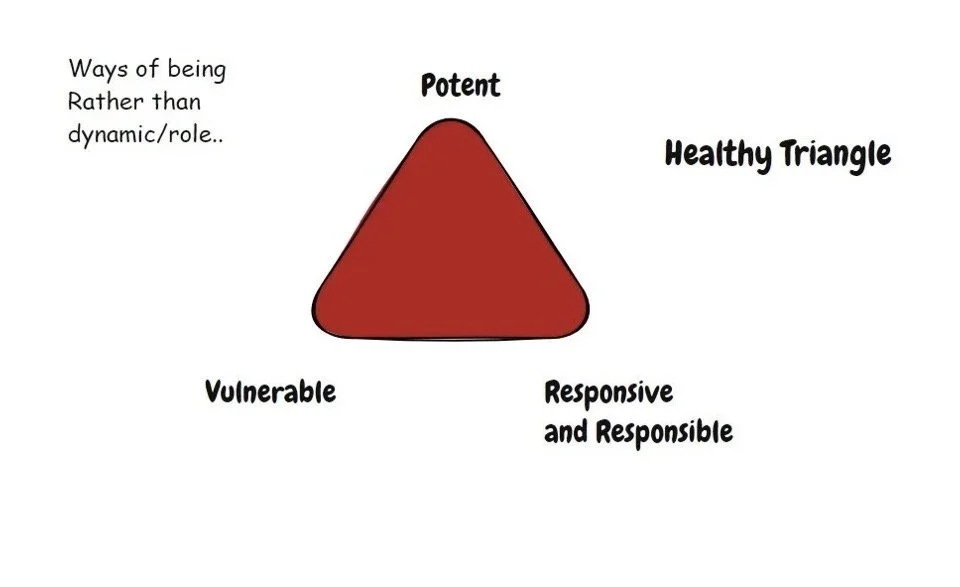
Healthy Triangle (after Proctor & Tehrani; via Emma Redfern):
This one brings the triangle back from interpersonal dynamics to healthy ways of being ie acting from Self and speaking for parts. We can apply it internally first, and then “return” to the other person and the relationship. (And notice how solid this triangle feels with that grounded base.)
An IFS version might look like:
Vulnerable with agency
Caring without over-functioning
Boundaries without blame
In other words Self leadership. From Self we can:
Speak for parts
Set limits
Offer help rather than take over
Allow others their own responsibility
Repair quickly when protectors take over
The golden thread
The way out of the Drama Triangle: inside or between us is the same: Pausing. Inviting you to Slow down. Track your state. Make the You-turn. Meet with your protectors and the tender ones if you’re able. Self overviewing the system, aware of all parts polarised and otherwise. These roles are not flaws They are protectors who took on too much at too young an age when they had to do it alone
When they trust Self is available:
Boundaries can become respectful rather than harsh
Care becomes supportive rather than over-reaching
Vulnerability gains strength and choice
And the triangle loosens.
A final thought
Context matters. Power matters. Safety matters in this world we live in
Sometimes victimhood is real and protection must come first.
Maybe what looks like drama is a system doing its best to avoid shame, or powerlessness. Hurt. Internal vulnerability. With Self leadership we can be more potent, more responsible and responsive as well as vulnerable when the system feels safe to be.
I’m curious how this lands for you. When you notice the triangle outside or inside: what do you see in your own system?
Clarity? Resistance? Recognition?
Not bad people. Not bad parts.
Just protectors doing their best with the worldview they see out of and with Self leadership available there’s a way though ☀️
For more IFS drama triangle blogs see:
Alessio Rizzo https://www.therapywithalessio.com/articles/getting-out-of-the-victim-persecutor-and-rescuer-state
Phil de la Haye https://www.facebook.com/share/1AzuahaYZZ/?mibextid=wwXIfr
My longer version of this blog post (part of my IFS community drops ins)
https://www.stroudtherapy.com/news/2024/02/25/dramatriangleifs
Alister Gates https://alistergates.com/the-drama-triangle-through-an-ifs-lens-a-different-way-to-understand-the-roles-we-get-stuck-in/
Corene Crossin:
https://www.anewchapter.com.au/blog/drama-triangle-ifs-therapy-relationship-patterns