
The Dance of the Protectors - Part 1
Parts Mirroring - What Happens inside You
February begins the foundations : the didactic starting point - our month on Parts Mirroring - part 1 of the Dance of the Protectors - and a crucial aspect in the year of navigating relationships
Each month this year I’ll begin by laying out a map. Whether you come along to our experiential circles or not I’m hoping you’ll bring your curiosity into this didactic blog which offers the framework we will be using as we explore relationships through an Internal Family Systems lens, alongside IFIO, Relational Life Therapy and polyvagal theory. Different language, same nervous system reality.
Before we look at what happens between two people, we begin with what happens inside one. This month is about Parts Mirroring .. noticing what shifts in your body, what feelings arise, and what story you tell yourself when something lands..
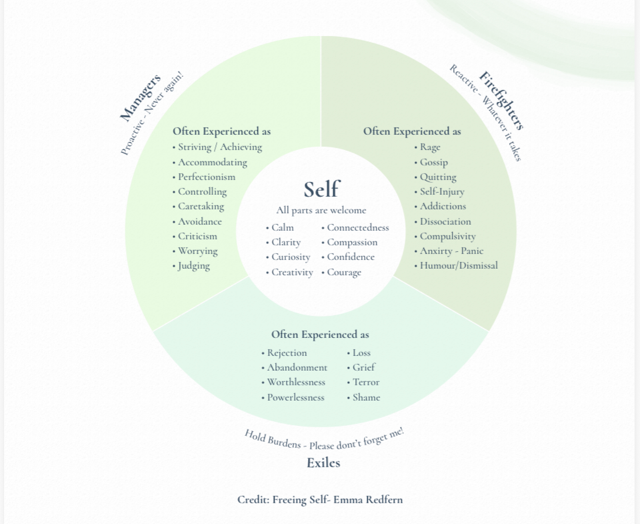
A brief recap of IFS parts
In Internal Family Systems we understand that we all have an inner system made up of parts, alongside our core Self
• Protective parts whose job is to keep us safe. Some are proactive and organised, trying to prevent harm before it happens. Others are reactive, stepping in quickly when something already feels threatening.
• Tender exiles who carry vulnerability, unmet needs or old hurt from earlier experiences.
• Self, our calm, curious, compassionate presence that can hold the whole system with perspective.
None of these are problems to fix. They are all intelligent responses to what we have lived through.
Part 1: When Something Happens
Before the argument. Before the escalation. Before the “dance”.
Something lands. A tone. A look. An interruption. A forgotten task…inside you, something shifts.
Your body registers it first. A tightening in the chest. A drop in the stomach. Heat in the face. Shoulders bracing.
A feeling follows. Hurt. Shame Fear. Anger. Loneliness.
Then comes the story. “I don’t matter.” “They’re too much.” “I’ve got to fix this.”
“I’m getting it wrong.”
This is Parts Mirroring. Your system responding to theirs. Not yet a fight. Not yet distance. Just activation.
Why this matters in relationships
Relationships are where our inner systems are most likely to be activated.
When two people come together, two nervous systems come together. Under stress, tiredness or emotional charge, it is far more common for protectors to meet than for Self to lead. In part 1 we are not focusing on the other person yet.. We are focusing on the body… the feeling and the story.. All inside.. Conflict is rarely aobut what just happened but about what each persons protectors felt like and believed inside us.
Different maps Same physiology
You may hear different language across the models we are drawing from this year
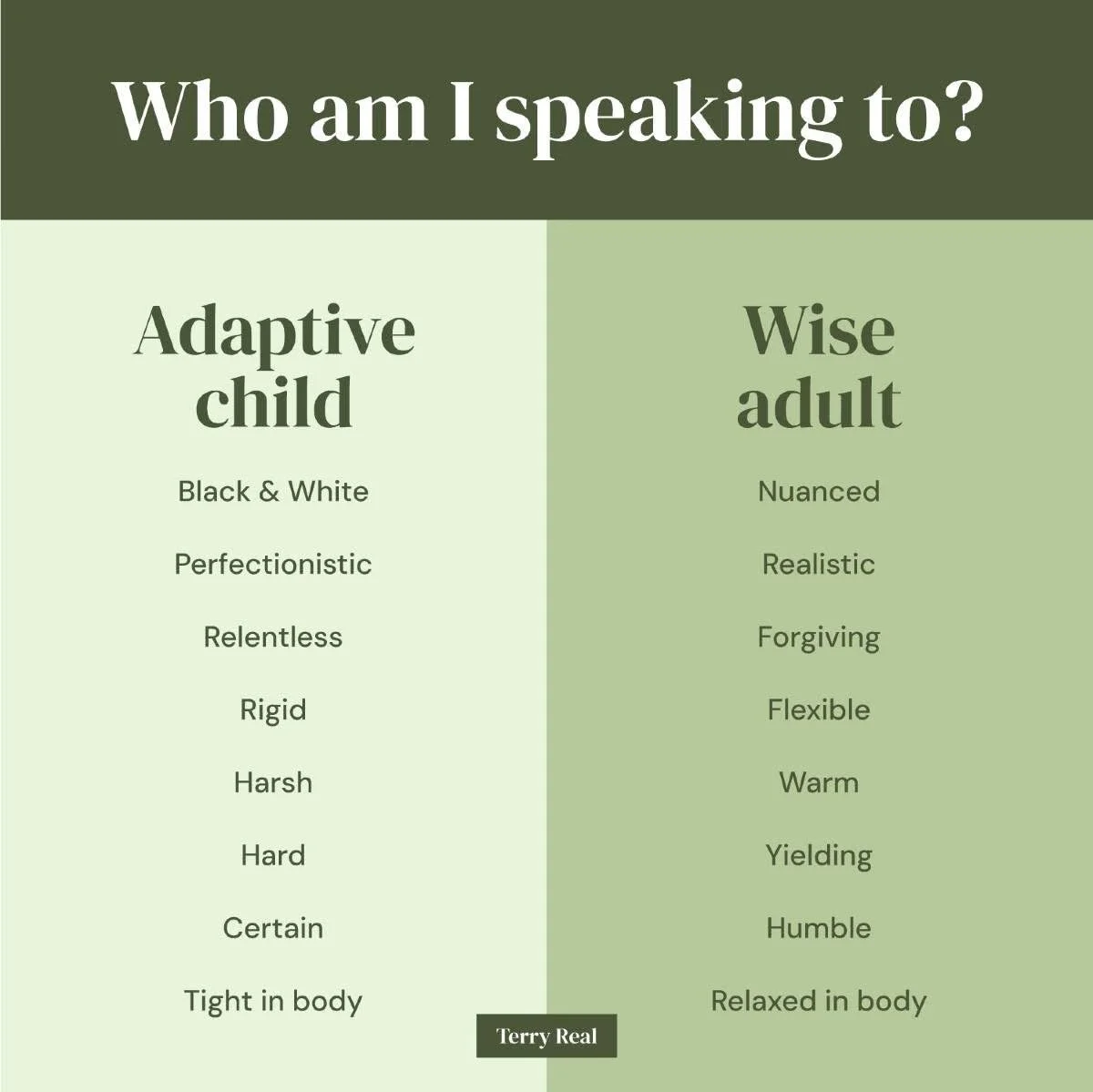
In Relational Life Therapy, both proactive and reactive protectors are broadly grouped as the behaviours of the Adaptive Child, while exiles are understood as the Wounded Child. Self corresponds to the Wise Adult.
In polyvagal terms, Self aligns most closely with a ventral vagal state of safety, connection and curiosity. Protective parts often operate from sympathetic activation (fight flight) or dorsal vagal responses like shutdown, depending on their role. Or a combo for fix and fawn. Exiles are frequently linked with collapse or shutdown when overwhelmed.
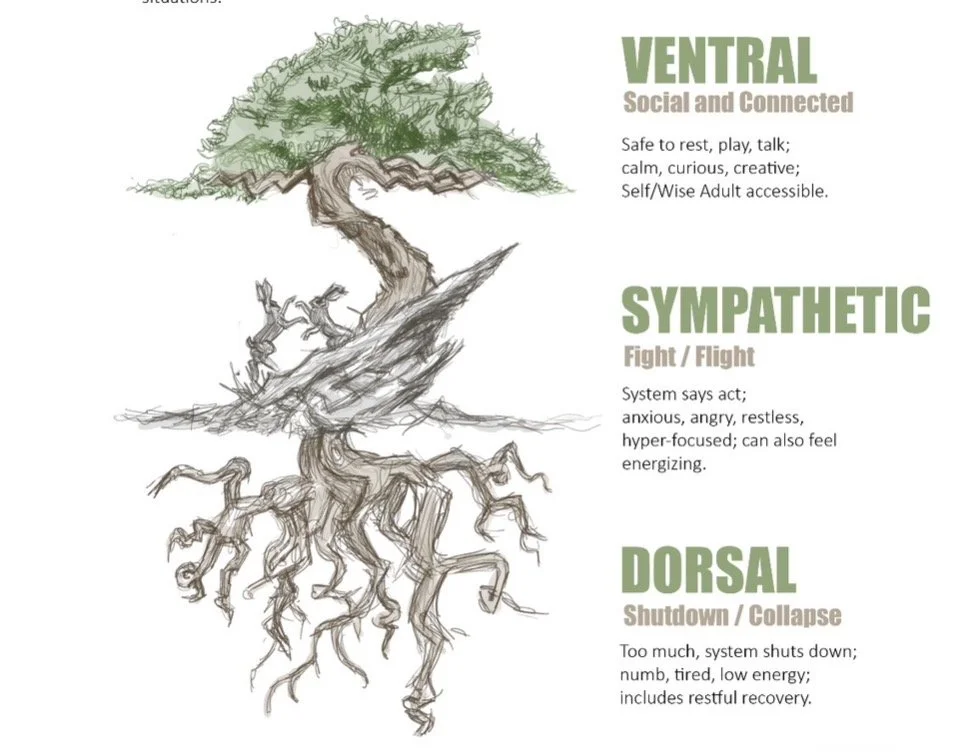
Different maps. Same underlying physiology.
What we are building towards..
In IFIO when two peoples protectors meet it is called The Dance of the Protectors. In RLT it is known as Stance Stance Dance. That we’ll explore next month - Part 2 We’ll explore what happens when your internal reaction meets someone elses.
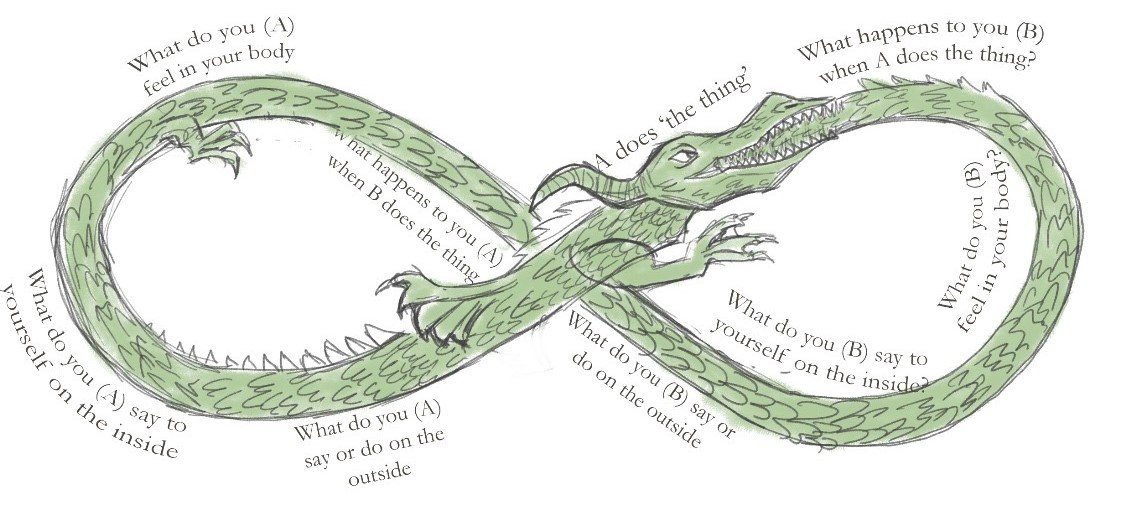
For now, we slow down the first half of the sequence:
Something happens. Your body reacts. A feeling arises. A story forms. That is the beginning of the dance.
This month
In the circles we’ll explore this experientially through meditation, parts mapping and perhaps sculpt work. If you’re local to Gloucestershire, you’re very welcome to join us. If you’re based in the UK or Ireland, you can join online.
Alongside this, I’ll be sharing short teaching videos – playful, hopefully accessible explorations of IFS – joined this month by Louise Dykes and Paul Dykes. We’ll begin mapping these inner sequences before we map the full dance. These videos are available on Facebook, Instagram and YouTube, and will be collected here on the website at the end of the month.
Tomorrow’s video
Something small happens. Someone does something ordinary. In the example, Lou is enthusiastic and interrupting. My nervous system registers alarm. A tender part is stirred. A protector rushes in. A story forms: she’s too much, she’s taking over.
Before we even get to the argument, the dance has begun inside. Throughout February we will gently unpack these moments. Not to assign blame but to build awareness, compassion and choice. Part 1 is about noticing what happens in you. Part 2 will explore what happens between you. When you can see the first half clearly, the second half begins to change.
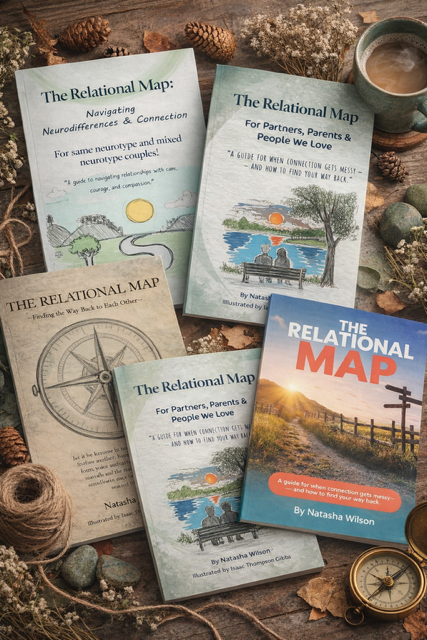
Here is a graphic of the 4 Relational Maps, priced at £4 each, you can download or I can send a physical copy - they have all the navigating relationships theory I’ll write about in one place.