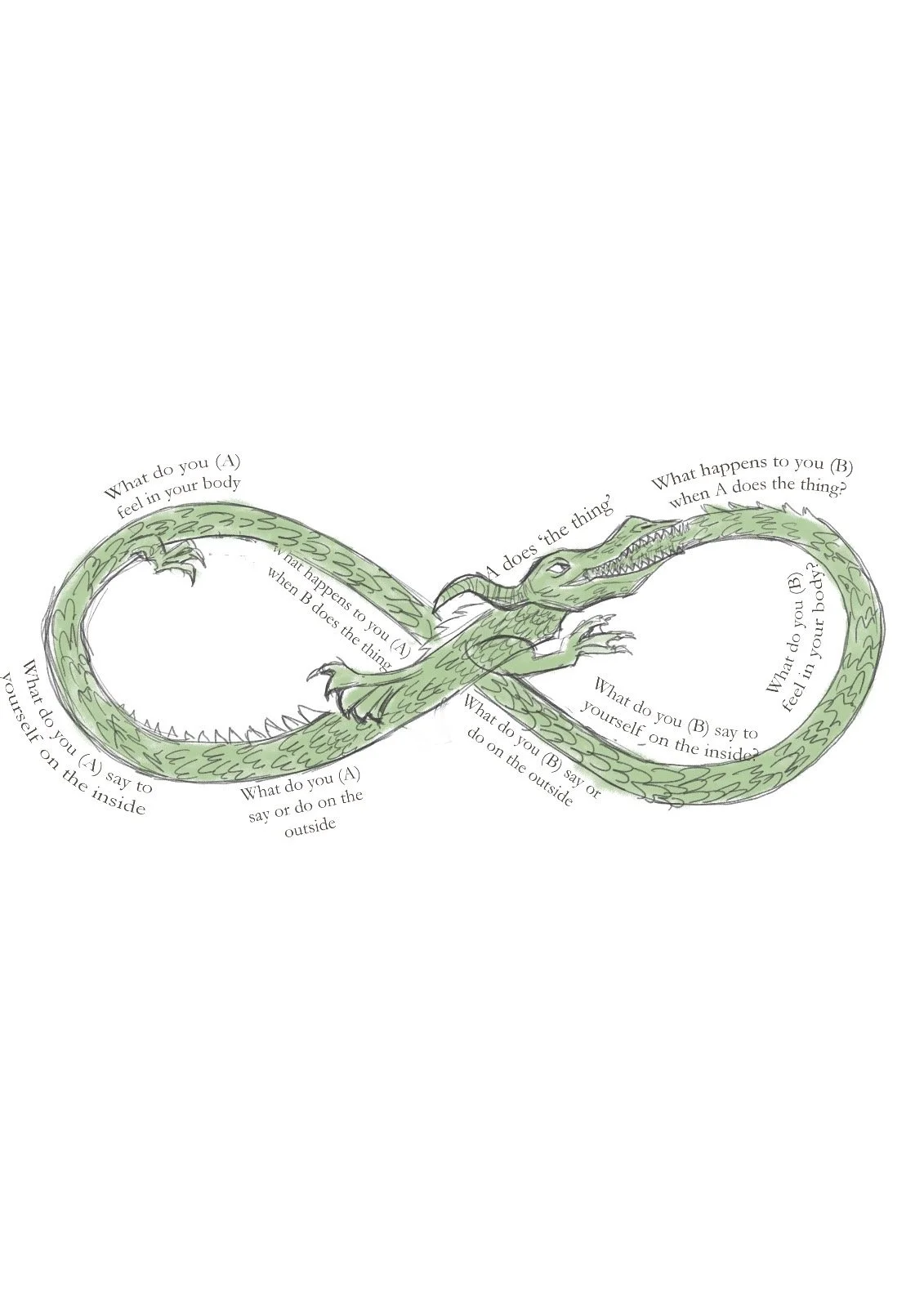
Dance of the Protectors - Part 2
When Two Inner Worlds Meet
Last month we slowed the sequence down and began with what happens inside you when something lands. i invited you to notice whensomething happens what do you feel somatically in your body… A body sensation… where do you feel that thing landing in your body. What then happens… maybe you get a feeling. An emotion.. of sadness loneliness, fear, notice! Then you might start telling yourself things … What story do you say abut them.. about you?
That was Part 1. This month we move into Part 2.
What happens when your inner reaction meets someone else’s? relationships are not just one nervous system responding. They are two.
When Protectors Meet
In IFIO this is called The Dance of the Protectors. In Relational Life Therapy it is known as Stance–Stance–Dance. Different language. Same reality.
When one person’s protector moves, it almost always activates something in the other.
You correct. They withdraw. You withdraw. They pursue.
You get louder. They go calmer. You go calmer. They get sharper.
This is not coincidence. It is nervous systems responding to nervous systems.
The Sequence
Let’s slow it down.
Something happens.
Person A’s body reacts.
A protector moves on the outside.
Person B’s nervous system responds — not just to the event, but to A’s protective move.
B’s protector now moves.
A reacts to that move.
And suddenly, protectors are talking to protectors.
Neither person feels fully seen. Both feel activated. Both are trying to stay safe.
The “More / More” Loop
This is where the infinity loop forms.
The more I push… the more you pull away. The more you pull away…the more I push.
The more I fix…the more you feel unheard.
The more you shut down…the more I escalate.
Every couple has their own choreography. Sometimes they are simple like the push pull example.. sometimes there’s an extra step (like one person will initially do x and in the next round they’ll do y) and sometimes the dance shifts as different parts come in (so sometimes I’ll argue back - a defensive protector - for example.. other times I might have withdrawl as a strategy of my protectors). Familiar?
No one plans these dances. They are rarely conscious choices. In later months we might look a bit into where these came from. If you feel up to it you could notice if some of these patterns were present in childhood… as a protective strategy - or maybe one of your caregivers modelled them?
As always lets remember that these are hardworking well intentioned protectors doing their best to prevent pain, shame, rejection or helplessness often colliding with someone else’s protectors doing exactly the same.
So?
Conflict is rarely about what just happened instead it is most likely about what each person’s tender ones felt and then what protectors did then.. What story it told.What move it made and how the other system responded. How often the dance gets stuck on repeat and disconnection eats away at intimacy.
When we stay focused on who is right, the dance tightens. When we notice the pattern itself we can change the conversation between us:
What Changes the Dance
The aim is not to eliminate protectors. The aim is to notice the rhythm, notice the parts involved. Pause long enough for Self to come online. In IFS language, that means unblending so creating just enough space from the activated part to respond rather than react. In RLT terms, it means stepping out of ones Adaptive child stance and into Wise Adult. In polyvagal terms, it means returning to ventral safety. Different maps. Same physiology. We’ll look at this more deeply down the line this year, at the moment we’re noticing our protector dances… big ones and little ones.. At home with a partner… maybe also with family members, our kids or parents.. at work or school… I personally enjoy noticing dances between people on the telly!
This Month
In our circles we’ll be exploring these dances experientially through meditation, mapping and sculpt work. If you’re local to Gloucestershire, you’re warmly welcome to join us. If you’re in the UK or Ireland, you can join online. Alongside this, I’ll continue sharing teaching videos and real-life enactments with colleagues. We’ll be mapping common protector pairings and slowing down the “more / more” loops that many couples recognise instantly. Not to assign blame but to build awareness, compassion and ultimately choice.
February and March
We’ll be looking at different dances in a spiral learning way (so videos will be about one dance a week - “real people” ie me and a colleague and an animated version). We’ll start next week with the Pursuer Distancer. In couples therapy literature, this Pursuer–Distancer dynamic (often researched as the Demand–Withdraw pattern) is one of the most frequently observed negative cycles in Western relationships. Research by John Gottman has shown how criticism on one side and defensiveness or stonewalling on the other can create escalating conflict cascades, while Sue Johnson’s Emotionally Focused Therapy describes a similar pursue–withdraw attachment loop, where one partner protests disconnection and the other protects against overwhelm or shame. Across models, the language differs, but the pattern is familiar: one moves toward, the other moves away, and both feel increasingly alone.
While this may be one of the most studied dances, it is far from the only one. Couples also become stuck in over-functioner/under-functioner loops, fixer/feeler patterns, overt/covert anger dynamics, planner/delayer tensions and many more.
The choreography varies; the nervous system logic underneath is strikingly similar. Hope you’ll enjoy them and start to notice your patterns 🤗
An Invitation
Notice your dance. Not the content. Not who is right. The pattern. When something happens:
What happens inside you? (Somatically… what emotions/feelings arise… what do you say to yourself about the other and yourself?)
What happens next between you? (what do they do in response to your action? What do they say?… what then do you do… and then what happens next?
can you notice your ‘ the more I do this the more you do that… then the more I do this then you do that?
Every relationship has a number of protector dances … and maybe there’s one that is so familiar, it’s stuck on repeat, it’s the one you keep coming back to. Sometimes it’s simple… sometimes a little more complicated with a number of side quests and different steps! The work is not to stop dancing. It is to notice and become aware of it, name it and notice how it doesn’t work for you both. Notice the hurt and loneliness and disconnect … if you can with the other too… awareness, acceptance… before you change the rhythm.