My favourite Polyvagal suggestions, links, podcasts, videos and reading recommendations

Polyvagal Favourites
Quick primer (and my IFS + Polyvagal notes)
These notes accompany the Stroud IFS Drop-In session from 2023. Nb I’ve put it through Claude Ai and have asked for useful extras and to make my notes read easier!
Seth Porges' lively Nerd Nite introduction to Polyvagal Theory is an excellent, accessible starting point available on YouTube.
Polyvagal Theory is the physiological platform underneath all therapies. Learning to read your nervous system state is an act of radical self-compassion.
How I Integrate Polyvagal with IFS
I treat Polyvagal as the physiological platform that underpins parts work: map state shifts (ventral / sympathetic / dorsal), then invite Self-energy to lead. Co-regulation is not a 'nice-to-have' — it is biologically essential, and we intentionally build it into sessions and groups.
• Hierarchy, neuroception, and co-regulation are the three big anchors for everyday use.
• Vagal tone builds with repetition and relationship; change is often measured in months and years — that is normal and to be expected.
• No 'ventral supremacy.' We aim for flexibility and flow — not staying in one state at all times.
• When a part steps in to interrupt process, it is signalling that the nervous system has detected a cue of danger. First, support the state; then work with the part.
The Autonomic Ladder at a Glance
Deb Dana's ladder metaphor makes the three-state hierarchy immediately usable. The key skill is learning to locate yourself on the ladder without judgement — this alone reduces the system's sense of overwhelm.
🟢 Ventral Vagal — Safe & Social
• Calm, curious, connected, playful, open to others
• Self energy most accessible here in IFS terms
• Breath available; face soft; voice melodic
🟡 Sympathetic — Mobilised (Fight / Flight)
• Anxious, restless, irritable, overwhelmed, racing mind
• Managers and firefighters most active: hypervigilance, perfectionism, rage, impulsivity
• Breath shallow and fast; jaw tight; scanning for threat
🔴 Dorsal Vagal — Shutdown (Freeze / Collapse)
• Numb, disconnected, exhausted, hopeless, foggy
• Exiles often carry pain here: shame, worthlessness
• Voice flat; body heavy; hard to think or feel
Note: blended states also exist — freeze (sympathetic + dorsal), fawn (sympathetic + dorsal appeasement), ventral + dorsal (restorative rest), ventral + sympathetic (enlivened creative drive).
Specific Exercises — State by State
The goal is not to eliminate all stress states but to build autonomic flexibility — the capacity to move between states and find your way back to ventral. Use the exercise suggestions below as a personal menu. Notice what works for your system; not every exercise suits every person.
When You're in Sympathetic (Mobilised / Anxious / Activated)
The system has energy it needs to use. Work with the mobilisation, not against it then apply the brake gently.
1 · The Physiological Sigh
• Take a normal inhale, then add a second small sniffon top to fully inflate the lungs.
• Then a long, slow exhale through the mouth — twice as long as the inhale.
• Just 1–3 sighs is often enough to shift carbon dioxide balance and rapidly reset arousal. This is the body's natural built-in calming mechanism.
• You can do this discreetly anywhere.
2 · Extended Exhale Breathing
• Inhale slowly for 4 counts, exhale for 6–8 counts (or longer).
• The long exhale activates the vagal brake — slowing the heart rate and signalling safety.
• Aim for around 5–6 breaths per minute. Belly breathing (diaphragm expands on inhale) is more effective than chest breathing.
• A soft sigh, hum, or 'voo' sound on the exhale deepens the effect (see below).
3 · The 'Voo' Sound (Somatic Experiencing)
• Take a full breath in. On the exhale, make a low, resonant "Vooooo" sound from the back of your throat.
• Let it be deep and sustained — feel the vibration in your chest and belly.
• Repeat 5–10 times. Allow a natural pause (a breath or two of rest) between each.
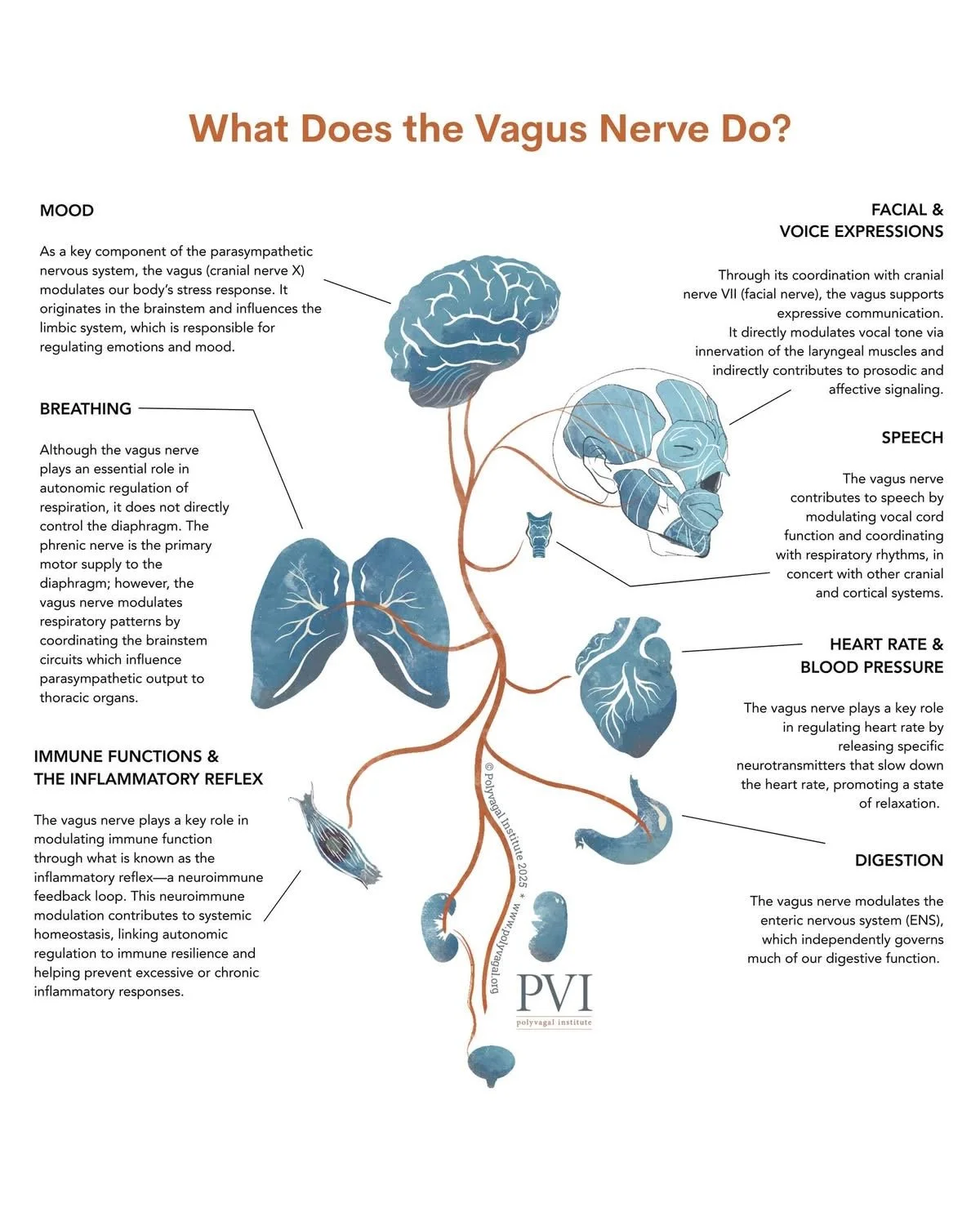
• The vagus nerve innervates the larynx and pharynx — vocalization directly stimulates it. This can feel powerfully grounding very quickly.
4 · Organised / Rhythmic Movement
• When activated, the body needs to move. Organised movement — walking, swimming, cycling, dancing, even vigorous cleaning — helps complete the defensive cycle so the parasympathetic can arrive naturally afterward.
• Rhythm is key: walking or swimming works better than a frantic dash. Match the rhythm to something stable.
• With someone else when possible — co-regulation during movement amplifies the effect.
• After 20–40 minutes, allow yourself to stop and rest: the parasympathetic recovery after aerobic activity is one of the most reliable routes to ventral.
5 · Cold Water — The Dive Reflex
• Splash cold water on your face, or hold a cold damp cloth on your cheeks and forehead for 30 seconds.
• Or: hold your breath and submerge your face in a bowl of cold water for 15–30 seconds.
• This triggers the mammalian dive reflex — an automatic, rapid slowing of heart rate via vagal activation. One of the fastest available techniques in acute anxiety.
• Cold water on the inner wrists or back of the neck also provides a proprioceptive jolt that brings awareness back into the body.
• Caution: avoid if you have a heart condition or blood pressure concerns. Start gently.
6 · Humming, Singing & Gargling
• Hum continuously on the exhale — any note, any tune. Feel the vibration in your throat and chest.
• Sing — even (especially) to yourself in the car. Group singing has been shown to increase heart rate variability and reduce cortisol.
• Gargle vigorously with water for 30–60 seconds. This activates the muscles at the back of the throat that are directly innervated by the vagus nerve. Sounds odd; works reliably.
• Chanting 'Om' has been shown in research to activate the vagus nerve and produce limbic deactivation — calming the brain's emotional centres.
7 · Shaking & Tremoring
• Animals naturally shake after a threat has passed — this is the body completing its stress response.
• Stand and gently bounce or shake from the feet upward: ankles, knees, hips, shoulders.
• Allow it to be messy and uncontrolled rather than performative — you are discharging activation, not exercising.
• 5–10 minutes is often sufficient. Sit quietly afterward and notice the shift.
8 · Chewing Gum / Jaw Release
• Chewing rhythmically stimulates the vagus nerve via the facial and jaw muscles and promotes saliva production — a parasympathetic signal.
• Even without gum: consciously relax your jaw (let it drop slightly), soften your tongue away from the roof of your mouth, and unclench your teeth.
• Many people hold chronic sympathetic tension in the jaw without realising it. Releasing it is a fast, discreet way to send safety cues to the system.
When You're in Dorsal (Shutdown / Numb / Collapsed)
The system has gone into conservation mode. The task is gentle re-mobilisation — not forcing yourself out, but coaxing the system back through sympathetic activation toward ventral. Go slowly; offer company.
9 · Tiny Movements First
• Don't try to exercise your way out of dorsal immediately — that can feel impossible and shame-inducing.
• Start with the smallest possible movement: wiggle your toes, rotate an ankle, roll your shoulders once. Even imagined movement (picturing yourself walking) can begin to activate the motor cortex and shift the system.
• Gradually escalate: move to standing, then walking slowly, then normal pace. Follow what the system can tolerate.
10 · Sensory Anchoring
• Cold water on your wrists, the back of your neck, or your face — this provides concrete sensory data that interrupts the disconnection of shutdown (different mechanism from the dive reflex — this is proprioceptive re-engagement).
• Hold something with texture: a smooth stone, rough fabric, a warm mug. Focus on the sensation.
• Greens and blues (colours in nature) tend to be calming and grounding — sit near a window or step outside briefly.
• A candle, a plant, a pet: any gentle anchor that gently cues the senses toward the present.
11 · Sound & Voice
• Make any sound. Hum loudly; it doesn't need to be pretty. Even low, quiet humming begins to activate the ventral vagal pathway.
• Put on an audiobook (a familiar, warm voice) or gentle comedy with voices — passive exposure to prosodic (melodic, safe) voices can help the nervous system begin to lift.
• Avoid very loud, jarring, or intense music which may re-activate sympathetic before the system is ready.
12 · Permission and Company
• First: check whether you're in restorative dorsal(ventral + dorsal — genuinely okay, replenishing) or collapsed dorsal (heavy, alone, hopeless). The former needs protecting, not changing.
• For collapsed dorsal: offer company — a warm human, a calm animal, even a warm voice on the phone or podcast.
• Permission to rest, without shame, matters. Self-energy meeting the collapsed part with compassion (rather than alarm or pushing) is itself regulating.
• Avoid high demands: no big decisions, no complex tasks. Small, manageable steps only.
General Exercises — Moving Toward or Anchoring in Ventral
13 · The Rosenberg Basic Exercise (Stanley Rosenberg)
From his book Accessing the Healing Power of the Vagus Nerve. Uses eye movement and the suboccipital muscles (at the base of the skull) to reset the vagus nerve. Takes 2–3 minutes.
How to do it:
1. Pre-test: slowly turn your head left and right. Notice range of motion and any stiffness.
2. Lie on your back (or sit). Interlace your fingers and place them behind the base of your skull, cradling your head. Elbows wing out to the sides.
3. Keeping your head completely still, move only your eyes to the right as far as comfortable. Hold for 30–60 seconds.
4. Wait for a spontaneous yawn, swallow, or sigh — these signal the nervous system shifting toward calm. Do not force them.
5. Return your eyes to centre. Rest briefly.
6. Repeat on the left side. Wait again for yawn/swallow/sigh.
7. Post-test: turn your head left and right again. Most people notice increased range of motion immediately.
• The suboccipital muscles (eight small muscles at the back of the skull) share direct neurological connections with the eye muscles and with the brainstem where the vagus nerve is innervated.
• Daily practice is Rosenberg's core recommendation.
• A guided audio version is on Insight Timer (search 'Vagus Nerve Basic Practice Christie Vallance').
14 · Orienting Practice
• Slowly and deliberately look around the room. Really see it — corners, colours, textures, objects. Let your eyes rest on something pleasant or neutral.
• This is the orienting response: the nervous system's pre-programmed scan for safety. When we consciously complete an unhurried orienting, we signal that the environment is safe and the threat has passed.
• Useful immediately after a triggering conversation or piece of news.
15 · Heart-Focused Breathing
• Place one hand on your chest, over your heart.
• Breathe as if through your heart: slightly slower and deeper than normal.
• While breathing, evoke a genuine positive feeling — gratitude, warmth for someone you love, a beautiful memory. Hold it sincerely.
• Extend the feeling outward to your parts, then to others.
• This practice (developed at the HeartMath Institute) improves heart rate variability and smooth autonomic rhythms. It is also a direct IFS-compatible self-to-parts compassion practice.
16 · The Ladder Visualisation (Deb Dana)
• Close your eyes and place yourself on the ladder. Name your state without judgement.
• Now slowly imagine taking one step up. What would that feel like in your body? What might change?
• You can pace this with breath: each exhale as one step upward, each inhale as a rest.
• You can do this alone or guide a client through it in session. Always end in ventral — even a brief taste of it.
17 · Safe Place / Ventral Anchor Memory
• Recall a specific memory or image of feeling safe, connected, and well — however brief or partial.
• Slow down into the felt sense of it: where do you feel it in your body? What colour, texture, quality does it have?
• This is not about positive thinking — it is about neurologically re-accessing ventral pathways. The body does not fully distinguish vividly imagined safety from experienced safety.
• Build a personal 'glimmer library' — a list of small moments that reliably produce a flicker of ventral. Return to it often.
18 · The Yawn (deliberate)
• Yawning directly stimulates the vagus nerve and is associated with parasympathetic activation and increased alertness in a regulated way.
• If you cannot yawn naturally, pretend to: open your mouth wide, stretch your jaw, and fake it. Often a real yawn follows.
• Yawning is also contagious — doing this with another person can prompt co-regulation through shared physiology.
19 · Co-Regulation — The Most Powerful Tool
• Find a warm, steady nervous system. A regulated human (or calm animal) is the most reliable route to ventral — more reliable than any solo exercise.
• You do not need to talk about what triggered you. Simply being in proximity to a regulated other begins to shift your system.
• In IFS terms: the therapist's Self energy is co-regulation in action. Richard Schwartz: 'clients respond as if the resonance of my Self were a tuning fork that awakens their own.'
• Build a co-regulation network: people who steady you. Be intentional about who regulates you vs. who dysregulates you.
Glimmers — The Everyday Practice
Coined by Deb Dana: glimmers are micro-moments of ventral vagal activation. They are the opposite of triggers — small cues that gently signal safety. With practice, cultivating glimmers retrains neuroception toward better detection of safety.
• A particular quality of morning light
• The sound of rain, birdsong, or running water
• A warm mug in your hands
• A pet settling beside you
• A piece of music that opens something in your chest
• A moment of genuine laughter
• Any moment of feeling truly seen by another person
Build your personal glimmer list. Keep it somewhere accessible. Return to it when the ladder feels steep.
Books & Core Texts
By Deb Dana
• The Polyvagal Theory in Therapy: Engaging the Rhythm of Regulation — Norton, 2018. Practical cornerstone for clinicians.
• Polyvagal Exercises for Safety and Connection: 50 Client-Centered Practices — Norton. Hands-on tool.
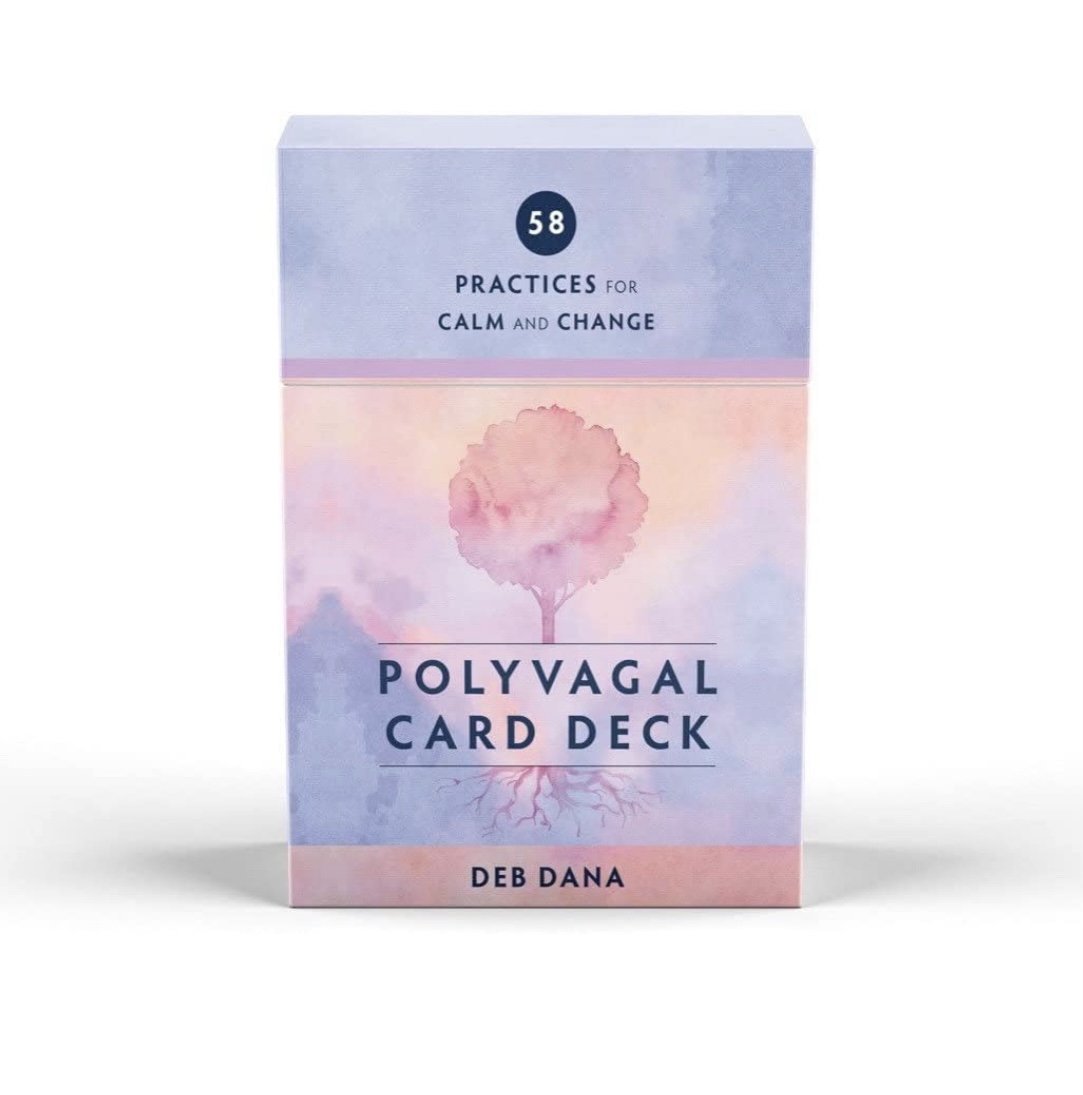
• Polyvagal Practices: Anchoring the Self in Safety — 2023. Short and practice-forward; includes a fresh overview chapter.
• Anchored: How to Befriend Your Nervous System Using Polyvagal Theory — Nov 2021. Accessible general reader.
• Polyvagal Prompts and Glimmer's Journal — Reflective practice tools.
By Stephen Porges
• Polyvagal Safety: Attachment, Communication, and Self-Regulation — 2021.
• Clinical Applications of the Polyvagal Theory — co-edited with Deb Dana. Edited collection from leading clinicians.
• Our Polyvagal World: How Safety and Trauma Change Us — Stephen W. Porges & Seth Porges, 2023. Accessible, story-rich; also on audio.
Other Notable Titles
• Accessing the Healing Power of the Vagus Nerve — Stanley Rosenberg. Practical somatic exercises including the Basic Exercise.
• The Polyvagal Theory Workbook for Trauma — Arielle Schwartz (New Harbinger, 2025). Hands-on exercises for nervous-system healing.
• The Polyvagal Institute maintains a current bookstore page at polyvagalinstitute.org
Key Articles & Papers
• Neuroception: A Subconscious System for Detecting Threats and Safety — Stephen W. Porges. The foundational neuroception paper.
• Polyvagal Theory: A Primer — Stephen W. Porges. Clear academic overview.
• Making the World Safe for our Children: Down-regulating Defence and Up-regulating Social Engagement to 'Optimise' the Human Experience — Stephen Porges.
• Vagal Pathways: Portals to Compassion — Stephen W. Porges.
• Brain-Body Connection May Ease Autistic People's Social Problems — Stephen Porges.
• Current lay overview for general readers: Verywell Mind — search 'Polyvagal Theory explained'
• Stephen Porges official publications list: stephenwporges.com
Podcasts, Talks & Demos
• Polyvagal meets IFS: A Talk with Deb Dana — IFS Talks podcast. Essential listening for anyone integrating the two models. Available on Apple Podcasts, Spotify, and internalfamilysystems.pt
• Seth Porges: Nerd Nite overview of Polyvagal Theory — lively, clear, and very accessible. YouTube.
• How Safe Do You Feel? Revolutionising Mental Health with Polyvagal Theory — Stephen Porges interview.
• SSP (Safe and Sound Protocol) podcast for clinicians and users — Apple Podcasts
• Rhythm of Regulation resources: rhythmofregulation.com
Practice Tools & Programmes
• Safe and Sound Protocol (SSP) — acoustic intervention; overview and pathways at Unyte Integrated Listening (integratedlistening.com)
• SSP Freely — 2023 playlist option with vocal music; same underlying algorithms
• Rhythm of Regulation — Deb Dana's clinical training series (rhythmofregulation.com)
• Emerging research use case: SSP with autistic children and occupational therapy — research.aota.org
• Polyvagal Institute — polyvagalinstitute.org — current bookstore, research, and practitioner resources
• Insight Timer: free guided audio for the Rosenberg Basic Exercise and Voo breathing
Polyvagal Library — Full Reading List
Books
• Anchored: How to Befriend Your Nervous System Using Polyvagal Theory — Deb Dana, Nov 2021
• Clinical Applications of the Polyvagal Theory: The Emergence of Polyvagal-Informed Therapies — Stephen W. Porges & Deb A. Dana
• Polyvagal Theory in Therapy: Engaging the Rhythm of Regulation — Deb A. Dana
• Polyvagal Exercises for Safety and Connection: 50 Client-Centered Practices — Deb Dana
• Polyvagal Practices: Anchoring the Self in Safety — Deb Dana, 2023
• Our Polyvagal World: How Safety and Trauma Change Us — Stephen W. Porges & Seth Porges, 2023
• Polyvagal Safety: Attachment, Communication, and Self-Regulation — Stephen W. Porges, 2021
• Accessing the Healing Power of the Vagus Nerve — Stanley Rosenberg
• The Polyvagal Theory Workbook for Trauma — Arielle Schwartz, New Harbinger, 2025
Key Articles & Papers
• Brain-body connection may ease autistic people's social problems — Stephen Porges
• Making the World Safe for our Children: Down-regulating Defence and Up-regulating Social Engagement to 'Optimise' the Human Experience — Stephen Porges
• Neuroception: A Subconscious System for Detecting Threats and Safety — Stephen W. Porges
• Polyvagal Theory: A Primer — Stephen W. Porges
• Vagal Pathways: Portals to Compassion — Stephen W. Porges


Warm wishes
Natasha