Meet Your Inner Team
If you've ever thought part of me wants to do this, but another part just can't .. you're already living IFS 🥳
Internal Family Systems is an evidence-based model developed by Dr Richard Schwartz, built on the idea that we are all multiple. We don't have a single fixed self. We have a whole inner family of parts, each with their own feelings, their own history, their own way of trying to keep us safe.. and at the centre of it all, a core Self: calm, curious, compassionate, and always there, even when it doesn't feel like it, maybe like the sun just hidden behind the clouds ..
Most of us have spent years managing our difficult parts rather than meeting them. Keeping the lid on. Staying functional. Getting through. IFS asks a different question: what if you got curious with them instead? Make friends with them? What are they protecting? What are they afraid would happen if they relaxed back?
When parts feel genuinely heard often for the first time things shift in ways that talking about a problem rarely achieves.
How IFS understands the mind
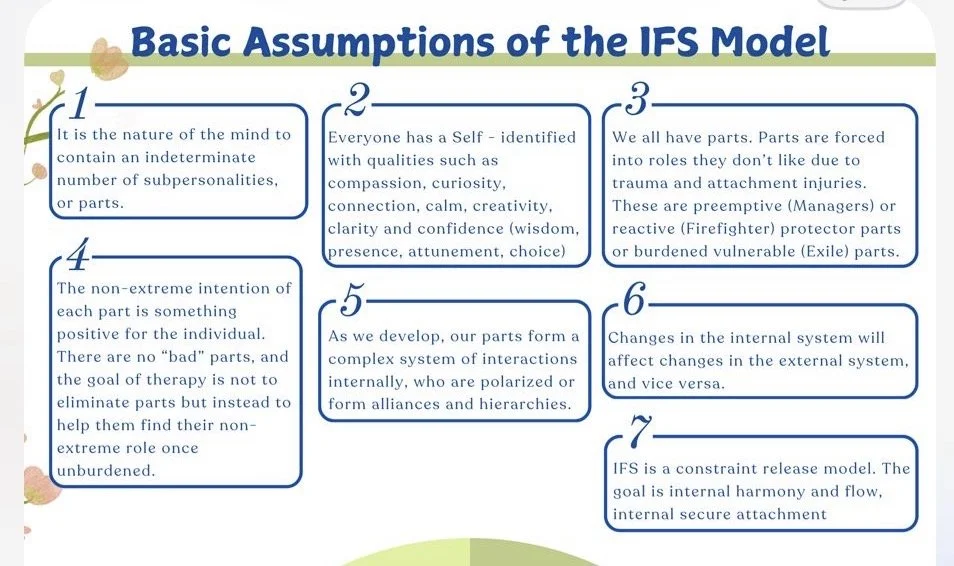
IFS starts with a radical assumption: it is the nature of the mind to contain an indeterminate number of subpersonalities, or parts. This isn't pathology. It's how we're all built. As we develop, our parts form a complex internal system… forming alliances, hierarchies, polarisations.. each trying to navigate the world in their own way.
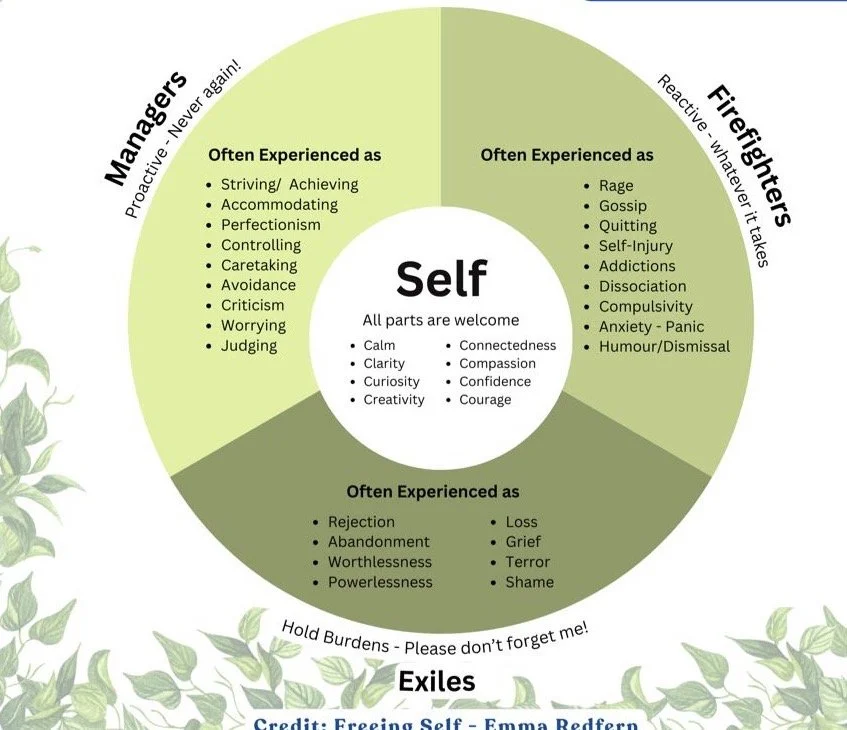
Parts don't choose their roles. They are forced into them by trauma and attachment injuries ie the moments when life felt unsafe, unpredictable, or too much. Some become preemptive protectors, the Managers, working hard to stop pain before it arrives. Others become reactive protectors, the Firefighters, rushing in when pain breaks through anyway. And underneath them all live the Exiles ..the burdened, vulnerable parts carrying the original wounds. Here's what IFS insists, and what makes it different from almost every other approach: there are no bad parts. Every part, however extreme its behaviour, has a positive intention. The goal is never to eliminate a part but to help it find its natural, non-extreme role once it's been unburdened.
At the centre of it all is Self, present in everyone, never damaged, identified with qualities like compassion, curiosity, calm, clarity, creativity, confidence, connection, wisdom and presence. IFS is ultimately a constraint release model. When parts feel safe enough to step back, Self can lead. The goal is internal harmony and flow a kind of internal secure attachment…because the internal and external systems are always in dialogue, when something shifts inside, things tend to shift in relationship too.
lets look a little deeper..
The protectors: managers and firefighters
IFS describes two kinds of protective parts.
Managers are the proactive ones. They like order, control, and predictability. They plan ahead, work hard, criticise and judge, both inside and out, keep the peace, apologise first, and stay two steps ahead of potential rejection. Their motto, if they had one, might be: never again. Never again will we feel the shame and powerless we did “back then”. Managers believe that if they can just hold everything together, nothing bad will happen. They are often exhausted. We often find they have frequently been at work since early childhood, almost always under 20!
Firefighters are the reactive ones. When pain breaks through, when the loneliness or shame or grief gets too close to the surface, Firefighters rush in to put out the flames. They protect through distraction, defiance, soothing. Drinking, scrolling, snapping, working late, shutting down, making a scene. Their goal isn't connection. It's relief. They'd rather cause a drama than feel a feeling. They are the unsung heroes of the inner world acting fast, doing what works, not worrying too much about the relational fallout.
What's important, and this is the part that changes everything, is that neither of them is the villain. Both are trying to help. Both are protecting something tender underneath.
The exiles: the ones we've hidden away
Underneath the protectors live the exiles. The young, vulnerable parts carrying old pain: rejection, abandonment, loneliness, worthlessness, grief, terror, shame. They're the reason the protectors work so hard. They hold the original wound, the moment it first became clear that needing people was dangerous, or that being yourself attracted criticism, or that love was conditional or absent or terrifyingly unpredictable.
Exiles are often young. Sometimes very young. They haven't been brought up to date with the rest of you. They don't know how much has changed.
The managers and firefighters developed their strategies to keep these tender parts hidden, not out of cruelty, but out of love. They learned that when the exile showed up, things got harder. So they got busy, or they got loud, or they got numb. All in service of the same small one hiding underneath.
Self
At the centre of it all, underneath or around all, the busyness and reactivity and noise, is Self.
Not the self that gets triggered. Not the self that makes the list or reaches for the wine or shuts the door. Something deeper. What some traditions call soul, source, Buddha nature. The IFS model describes Self through eight qualities: calm, curiosity, clarity, compassion, creativity, confidence, courage, connectedness. We could add in here presence, wisdom, nuance, flow
Self isn't a part. Self is the awareness that can hold all the parts without being swept away by any of them. The captain of the ship. The conductor of the orchestra. The one who can sit with what was once too much to bear because Self, unlike the parts, is not frozen in the past. Self has grown up and is all ages
The work of IFS isn't to get rid of your protectors or push the exiles away. It's to help the parts discover that Self is here. Present. Grown. Able to be with what they've been carrying. When they really feel that not just hear it, but feel it something shifts. The protectors begin to soften. The exiles begin to emerge. The whole inner system starts to breathe.
What makes IFS different?
Rather than managing anxiety or quietening your inner critic, we get curious with them. What are their hopes? What are they protecting? Who are they polarised with? What are they afraid would happen if they relaxed? When do they turn up? How old are they? When parts feel genuinely heard annd attuned with .. often for the first time .. things shift in ways that talking about a problem rarely achieves.
IFS is, in my experience, creative, engaging, and sometimes surprisingly fun. Clients regularly tell me it feels unlike any therapy they've tried before.
Each Monday in April I'll be posting a short video skit at my kitchen table, bringing these parts to life. It's hopefully a little bit funny. It's a little bit real. It's always about parts I know well and what becomes possible when Self shows up.
(As an Audhdr there’s also my wiring underneath..)
See you Easter Monday.
If you want to go deeper — IFS reading worth your time
No Bad Parts — Richard Schwartz. A brilliant entry point for beginners and a wonderful revisit for those who already know the work.
You Are the One You've Been Waiting For — Richard Schwartz. IFS brought into intimate relationships. Explores how our parts influence our closest connections and what Self-led love actually looks like.
Self-Led: Living a Connected Life With Yourself and With Others — Seth Kopald. A warm, practical guide to bringing IFS into every area of daily life relationships, work, parenting, spirituality. Highly readable and immediately useful.
Transcending Trauma: Healing Complex PTSD with IFS Frank Anderson. For those wanting to go deeper into the trauma-informed dimensions of IFS. Full of clinical wisdom and deeply compassionate.
-
IFS 101 & Relational Recap is the title of the IFS drop in groups this month... Short videos every Monday, starting Easter Monday 6th April. Follow along on Instagram and Facebook @natashawilson.ifspsychotherapy Or FB Natasha Wilson IFS & IFIO therapist, UKCP psychotherapist