Introducing the New Relational Map for Neurodivergent & Mixed-Neurotype Couples 🥳
I’m thrilled to share my latest Relational Map: a new guide designed especially for neurodivergent and mixed-neurotype couples.
This map integrates three of the frameworks closest to my heart — Internal Family Systems (IFS), Intimacy from the Inside Out (IFIO), and Relational Life Therapy (RLT) — alongside the brilliant work of Kelli Murgado-Willard, whose book Neurodiverse Couples Therapy I often draw on in my practice.
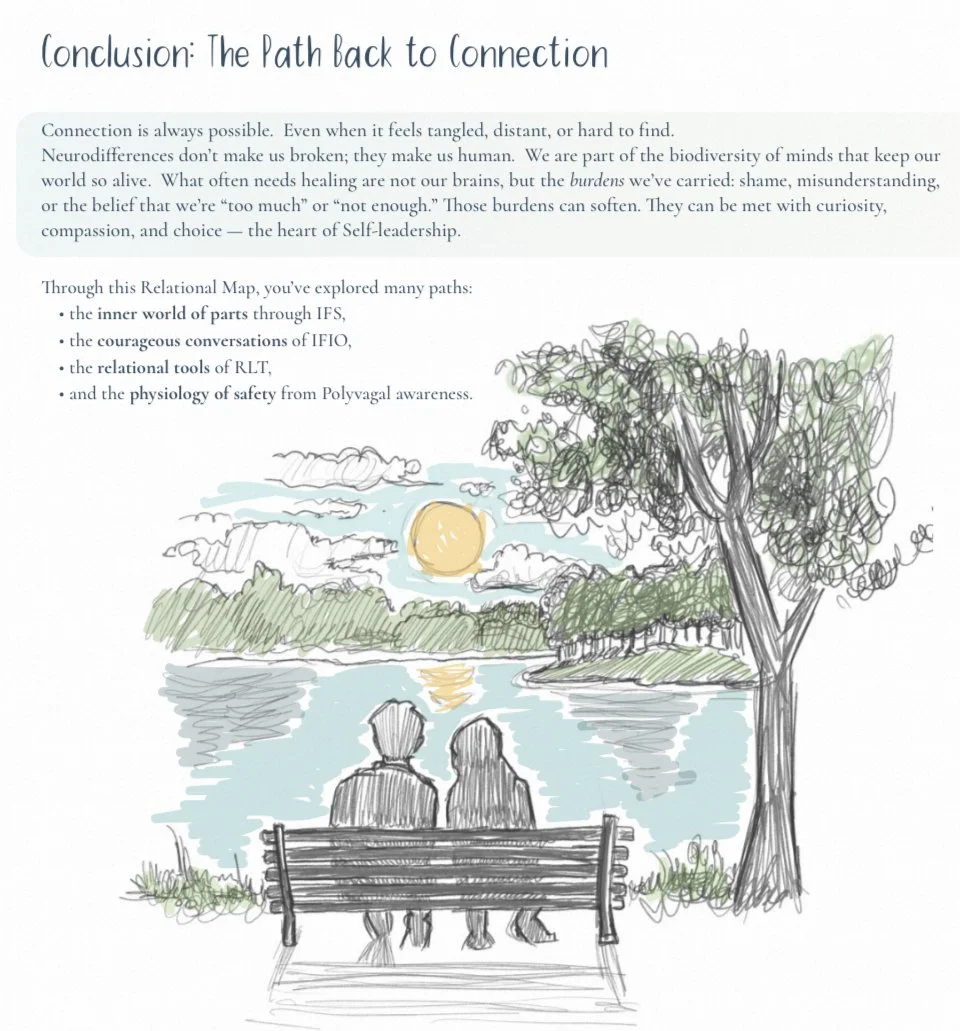
Beautifully illustrated by Isaac Thompson Gibbs (local to Stroud, now studying in Scotland), this new map is both practical and deeply human — a visual companion for understanding difference, repair, and connection.
Why a Map for Neurodivergent Relationships?
Relationships can be complex for all of us, but when different neurotypes come together — or even when two people share a similar neurotype but very different sensory or communication styles — the potential for misunderstanding multiplies.
Many of the resources available still assume a “neurotypical” baseline. They focus on how neurotypical people can “understand” or “manage” their neurodivergent partners, rather than viewing both partners as fully human, both with needs, traits, and protective parts that make perfect sense in context.
This map aims to redress that imbalance — offering language, compassion, and frameworks that work for everyone.
What’s Inside
The new Relational Map includes:
Practical tools and clear theory to help couples understand and navigate their differences
The Double Empathy Problem — how communication breaks down between different neurotypes, and how to repair it
A “hardware, software, and viruses” metaphor for the brain — recognising the innate traits we’re born with, the learned strategies we adopt, and the burdens we can unburden
U-Turns and Repairs — tools for pausing, reflecting, and returning to connection
Boundaries, esteem, and the 5 Losing & 5 Winning Strategies from RLT
And a gentle reminder that we all have protective parts and that healing begins when those parts start to trust Self
Part of a Growing Series
This is now the fourth in my Relational Map series, which began as a creative way to make complex relational theory more accessible:
🗺️ The Original Edition — for partners, parents, and families navigating everyday relationship challenges (24 pages)
🌟 The Mythical Edition — parchment style with dragons and egalitarian knights on high horses! Simple, clear and hopefully making the concepts playful and memorable (16 pages)
🌱 The Young Person’s Edition — an IFS-informed guide for teens and young adults
💫 The Neurodivergent Edition — this new addition, designed for mixed and shared neurotype couples (32 pages)
Each one blends clinical frameworks with visual storytelling, making the invisible patterns of relationship visible, relatable, and repairable.
How I Use the Maps
These maps aren’t just handouts. They’ve become central to my work, all the concepts are used in my therapy with individuals and couples, in workshops, and in our IFS Community Healing Circles.
Next year (2026), our circles across Gloucestershire and online will focus on Navigating Relationships: bringing together these ideas in a safe, supportive, and practical way.
I’ll also be sharing these maps with my clients, both in one-to-one sessions and in small closed groups, so that relational learning becomes something we can see, hold, and work with and not just talk about.
The Creative Process
Designing these maps has been a labour of love and Audhd passion, monotropism and dopamine. A mix of theory, artistry, and lived experience. Working with Isaac on the illustrations brings the whole project to life; his ability to translate psychological concepts into visual metaphors is extraordinary.
As always, my hope is that these resources help people see themselves and each other with more understanding, humour, and compassion.
The Neurodivergent Relational Map is now off to the printers and will be available soon on stroudtherapy.com and at the IFS Drop-In Healing Circles.
A Final Word
At their heart, all these maps are about finding our way back: to ourselves, and to each other. Most of us didn’t grow up with these tools - and connection isn’t something we have; it’s the something we build, lose, and rebuild again. 💛